Solar Panel Angle Calculator
Enter the installation latitude and longitude to estimate a fixed solar panel angle and the direction the panel should face. The recommendation is designed to favour the low-sun period around the winter solstice, when an off-grid system is most likely to need careful panel positioning.
This calculator is primarily intended for the Telemetry2U pole-mount 20W solar kit with IP67 enclosure and 12V 7Ah SLA battery . It can also provide a useful starting point for fixed Dragino solar-powered IoT installations, subject to the mounting instructions supplied with the device.
How the solar panel angle calculator works
The calculator uses the entered coordinates to model the sun's position through each minute of two representative winter days. It is deliberately focused on winter rather than annual average conditions because winter brings a lower midday sun and often less available solar energy.
- It selects the next winter solstice: June in the southern hemisphere or December in the northern hemisphere.
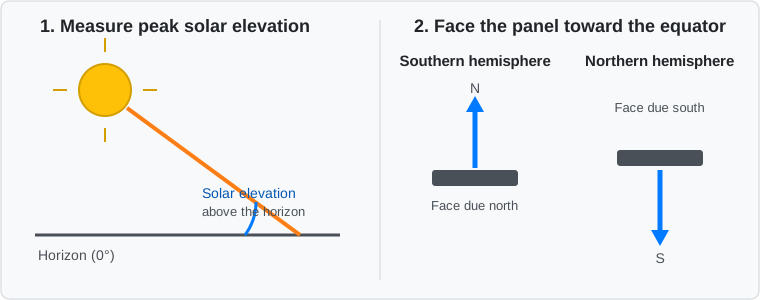
- It finds the highest solar elevation above the horizon on the solstice and records the UTC time at which it occurs.
- It repeats the calculation for 30 days before the solstice.
- It averages those two peak elevations and rounds the result to the nearest whole degree to produce the recommended mounting angle.
- It points the panel toward the equator: due north in the southern hemisphere and due south in the northern hemisphere.
Using the result on a remote solar installation
For the Telemetry2U 20W pole-mount kit, loosen the panel's clamping bolts, set the calculated angle with an inclinometer or phone angle app, confirm the panel faces the recommended compass direction, and tighten the bolts securely. Check the full pole-mount solar kit assembly instructions before deployment.
Angle conventions can differ between brackets and measuring apps. Before applying this result to another panel or a Dragino solar product, check whether its instructions measure tilt from the horizontal, vertical, panel face or mounting arm.
Solar panel angle questions
Why does the calculator use the winter solstice?
The winter solstice is when the midday sun is lowest in the sky. Optimising a fixed panel around this difficult part of the year can improve the reliability of battery-powered telemetry, LoRaWAN, NB-IoT and LTE-M equipment during low-sun conditions.
Why are both latitude and longitude required?
Latitude determines the seasonal path and height of the sun. Longitude is used to calculate when the sun reaches its highest elevation in UTC at the installation location.
Is the calculated angle guaranteed to keep a battery charged?
No. The angle improves panel orientation, but available energy also depends on panel size, battery capacity and condition, equipment load, temperature, weather, shading and system losses. Complete an energy budget and test the assembled system before installing it at a remote site.
What locations are supported?
The current calculator accepts latitudes from 60° south to 60° north and longitudes from 180° west to 180° east.