Remote Water Level Monitoring for Tanks, Dams and Reservoirs
Telemetry2U connects compatible water level sensors through LoRaWAN, NB-IoT or LTE-M so farms, businesses, councils and service providers can view tank and dam levels remotely, receive configurable alerts, review historical trends and integrate compatible pumps, valves and flow meters.
Know How Much Water Is Available Before It Becomes Urgent
Replace routine visual checks with a central dashboard that shows current level, calculated volume, usage trends, device health and alert activity across one or many locations.
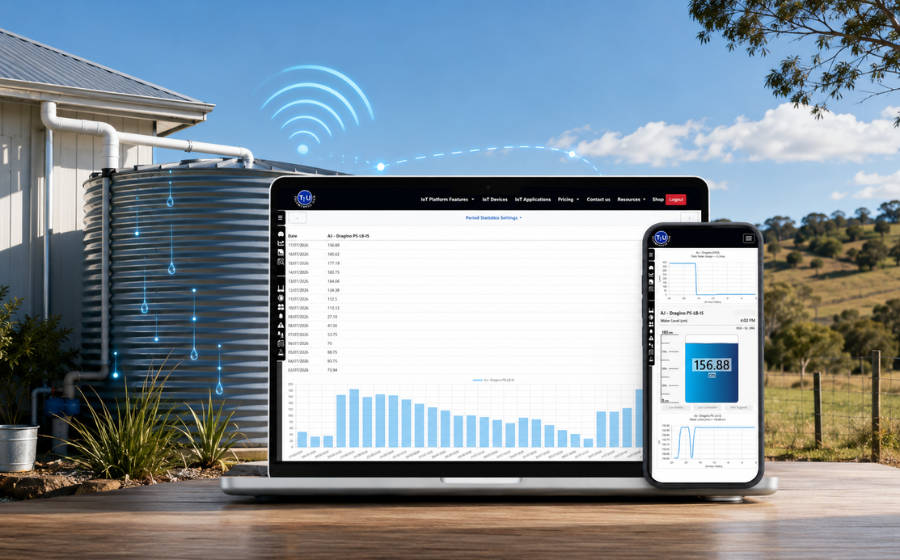
Monitor Water Availability Without Repeated Site Visits
Remote water level monitoring combines a suitable level sensor, wireless connectivity and the Telemetry2U platform. It gives authorised users a current view of stored water and a historical record that can reveal consumption, replenishment, rapid loss and developing supply problems.
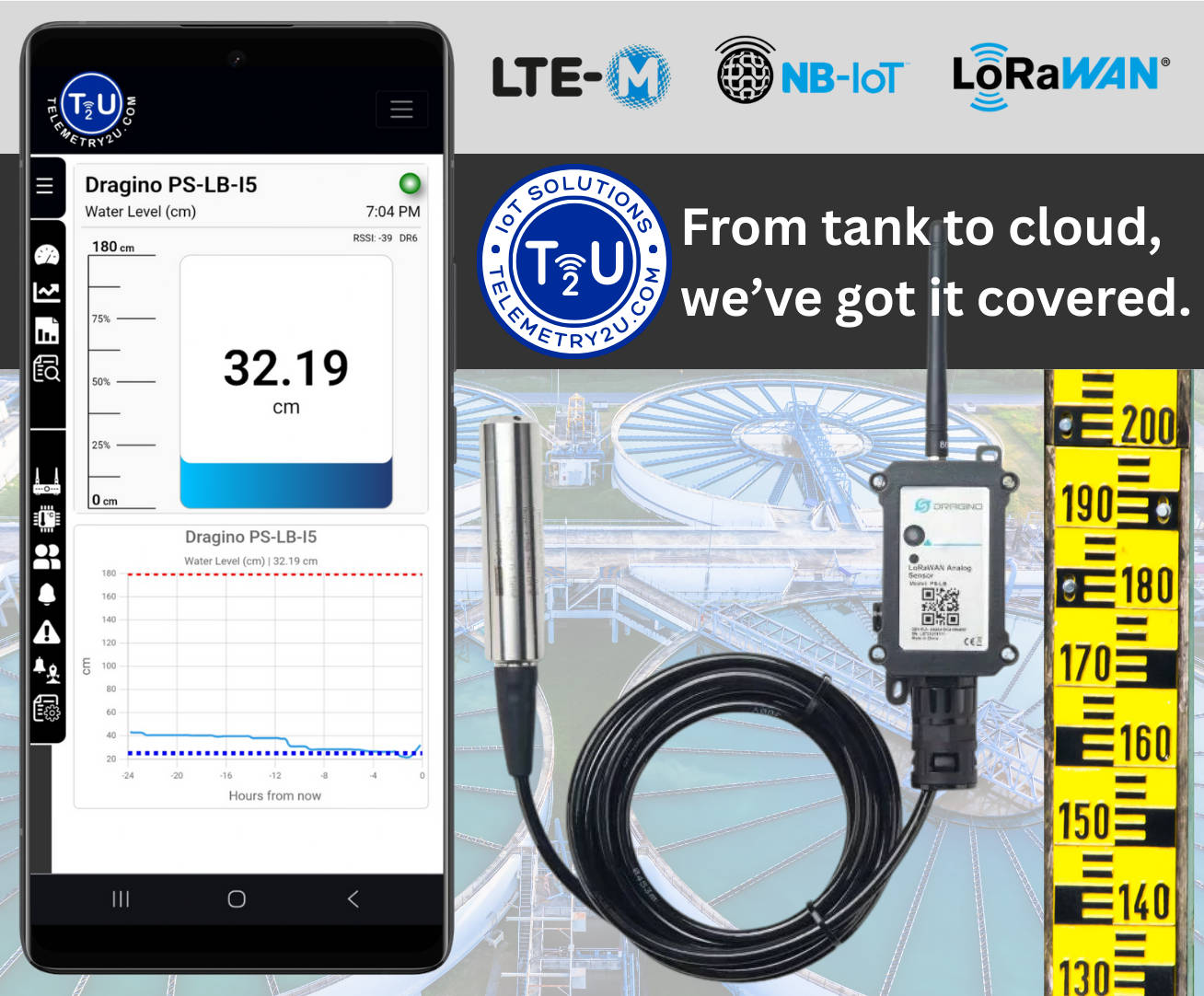
Practical Visibility for Tanks, Dams and Reservoirs
A remote water tank level monitoring system replaces routine visual checks with current readings, alerts and historical water-use trends. Telemetry2U helps operators check conditions remotely and direct attention to locations that actually need action.
- Low-level warnings: Notify nominated users before a tank or dam reaches a critical operating level.
- High-level and overflow warnings: Identify unexpected filling or a developing overflow condition.
- Rapid-change visibility: Review sudden losses that may indicate leakage, an open valve or abnormal demand.
- Calculated water volume: Convert measured depth into fill percentage and estimated litres using configured tank geometry.
- Historical water trends: Compare usage, deliveries, rainfall recovery and seasonal patterns over time.
- Reduced inspection travel: Check remote assets before sending staff, contractors or water-delivery vehicles.
- Device health: Review last communication, battery information and signal indicators where supported by the device.
The same deployment can be extended with compatible flow meters and pulse counters, pump status inputs, pressure sensors and control devices when the project requires more than level measurement alone.
See the Remote Water Level Monitoring Dashboard
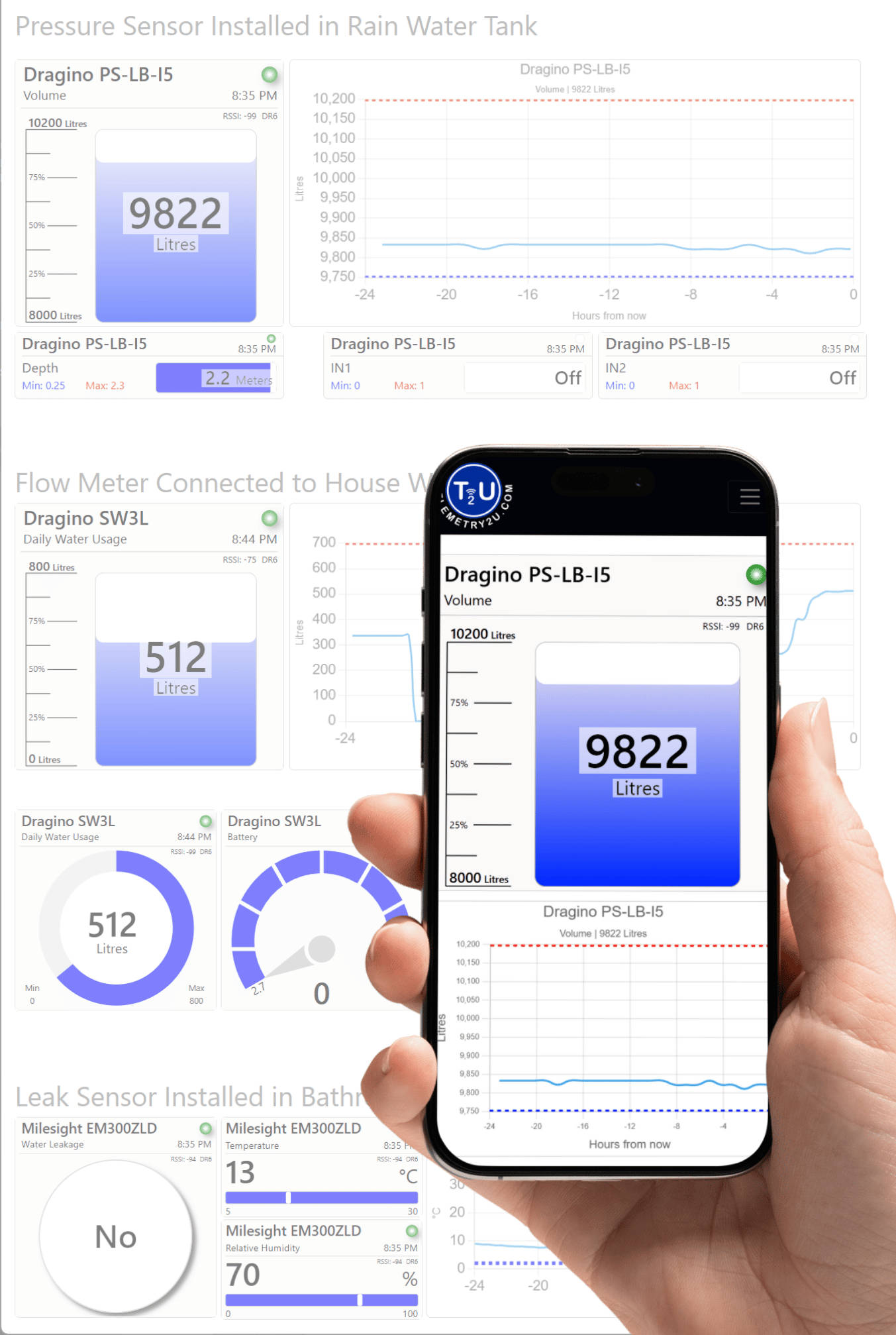
One View for Current Level, Volume and Historical Trends
View current water depth, fill percentage, calculated litres and recent changes from a phone, tablet or computer. The dashboard can combine level, flow, pump state and device-health information where those inputs are installed.
Turn Readings into Useful Operating Information
Dashboard widgets can be arranged around the application rather than forcing every site into the same display. A farm may prioritise tank volume and trough supply, while a water cartage operator may need a multi-customer refill view.
- Display depth, percentage and calculated volume.
- Review hourly, daily or longer-term water-level trends.
- Compare level changes with flow, pump or rainfall information where available.
- Identify alert conditions and the most recent device communication.
- Organise multiple tanks, dams, properties and customer locations.
Choose the Right Water Level Sensor for the Site
Sensor selection should be based on the vessel or water body, measurement range, mounting position, liquid conditions, required accuracy and maintenance access. Many supported radar and pressure-monitoring packages are battery operated, require little field wiring and can be supplied preconfigured for straightforward installation.
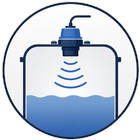
Ultrasonic Level Sensors
Non-contact measurement from above the water surface. Ultrasonic sensors can be practical for suitable tanks and open-water installations, but mounting, blind zone, condensation, foam, turbulence and obstructions must be considered.
Radar Level Sensors
Radar provides non-contact measurement from above the water surface. Battery-operated radar packages can be mounted without running mains power or placing a probe in the liquid, making many tank installations straightforward. Solar-powered options are also available where the reporting interval or connected equipment requires more energy.
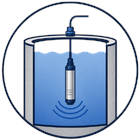
Submersible Pressure Sensors
A submersible pressure probe measures the water column from within a tank, bore or reservoir. Battery-powered packages can often be installed by lowering the probe to a known position, securing the cable and confirming the measurement range. Solar-powered options are available, while cable routing, venting, fouling and long-term access still need to be considered.
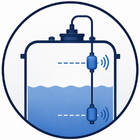
Float and Point-Level Switches
Float, conductive or point-level switches are suited to simple high-level, low-level and overflow states. They do not provide a continuous level trend, but they can be effective as a direct alarm input or independent safeguard.
Straightforward Installation for Remote Water Assets
Many water-level installations do not require mains power, trenching or a local data connection. Battery-powered radar devices can be mounted above the water, while pressure probes can be lowered into the tank or reservoir and secured in position. Compatible devices can be preconfigured before dispatch, and solar-powered versions are available for applications with higher power requirements.
Compatible 4–20 mA, 0–10 V, pulse, dry-contact, RS-485 and Modbus devices can also be integrated through a suitable Telemetry2U interface. The exact combination should be confirmed before hardware is ordered.
From Water-Level Measurement to an Operational Response
A useful monitoring system does more than collect a number. It moves a reliable reading from the field to the people responsible for water supply, then preserves enough history to support investigation and action.
Measure, Connect, Notify and Act
Measure
A suitable sensor measures water depth, distance to the surface or a defined high or low level state at the tank, dam or reservoir.
Connect
The field device sends readings through LoRaWAN, NB-IoT or LTE-M at the configured interval and when supported event conditions occur.
Notify
Telemetry2U records the condition and sends enabled email, SMS or voice-call notifications to the nominated users or escalation contacts.
Act
Staff investigate, arrange a refill, inspect a suspected leak or use compatible control hardware to operate a pump or valve under an assessed automation design.
LoRaWAN, NB-IoT and LTE-M for Water Level Monitoring
The best network depends on the number and location of sensors, available infrastructure, reporting interval, power supply and coverage at the actual installation point. Telemetry2U supports all three technologies so the network can be selected around the project.
NB-IoT for Fixed Remote Water Assets
NB-IoT devices connect directly to a supported cellular IoT network and do not require an on-site gateway. This can suit fixed tanks, dams and utility assets where compatible coverage is available.
- No local LoRaWAN gateway required
- Designed for small, periodic data transmissions
- Useful for isolated fixed-location assets
- Coverage must be confirmed at sensor height and location
LoRaWAN for Multiple Tanks and Sensors
LoRaWAN is well suited to farms, facilities and water networks where many battery-powered sensors can communicate through one or more correctly positioned gateways.
- One gateway can support many compatible devices
- Useful for tanks, dams, flow meters and pump-status inputs
- Low-power communication for periodic field measurements
- Coverage depends on terrain, structures and gateway placement

LTE-M for Distributed and Responsive Systems
LTE-M also connects directly to a compatible cellular network. It can suit distributed assets or applications that need more responsive communication, subject to device power and coverage requirements.
- No local gateway required
- Suitable for geographically separated monitoring points
- Supports more responsive communications on compatible devices
- Power design should reflect the reporting and control requirements
A Site Survey Is Part of Selecting the Network
Marketing coverage maps are not a substitute for checking the proposed sensor and gateway locations. Terrain, tank construction, vegetation, buildings, antenna position and the available internet connection can all affect the final design.
Water Level Monitoring for Agriculture, Industry and Distributed Sites
The same platform can support one critical rainwater tank or a distributed network of dams, reservoirs, process tanks, flow meters and pumps. The sensor and communications design changes, but the operational need remains the same: know the available water and respond before supply is affected.
Farms, Irrigation and Remote Properties
Monitor water supplies that are spread across large properties or difficult to inspect routinely.
Stock-Water Tanks and Trough Supply
Check the storage feeding livestock troughs and identify low levels before animals lose access to water.
Dams, Turkey Nests and Irrigation Storage
Track seasonal drawdown, replenishment and operating reserves across irrigation and farm-water assets.
Bore, Transfer and Header Tanks
Monitor water moved between bores, header tanks and distribution points, with pump status where suitable inputs are installed.
Remote Homesteads and Rainwater Storage
View household and property water reserves remotely and plan deliveries or transfers before supply becomes critical.
Facilities, Utilities and Service Providers
Centralise water-level information across operational sites, customer locations and critical storage assets.
Commercial Rainwater and Fire-Water Storage
Monitor non-potable water assets and operational reserves while retaining appropriate local safeguards for critical systems.
Process, Buffer and Wash-Down Tanks
Track production and service-water storage alongside flow, pressure or equipment-state information.
Councils, Utilities and Community Assets
Bring dispersed reservoirs and tanks into a central monitoring view for operations and maintenance teams.
Mining, Construction and Temporary Sites
Monitor temporary or remote water assets without relying on a permanent local network connection.
Combine Water Level, Volume, Flow and Pump Control
Level is often only one part of the water-management problem. Telemetry2U can combine compatible level sensors with flow meters, pressure measurements, pump-state inputs and control hardware so users can see both the available water and how the system is operating.

Turn Level into Useful Water Information
Configure depth, percentage and calculated litres, then use historical charts and period statistics to review consumption, refill events and changes over time.
- Calculated volume using configured tank geometry
- Daily or period-based change and usage summaries
- Flow-meter integration for direct consumption measurement
- Comparisons between storage level and water movement
Automate Compatible Pumps and Valves
Telemetry2U can issue commands or apply automation rules through compatible controllers. Common objectives include starting a transfer pump at low level, stopping filling at high level or disabling a pump before a source tank runs dry.
- Configurable thresholds, delays and schedules
- Remote commands through authorised user access
- Manual override and local protection retained where required
- Fail-safe behaviour designed around the application risk
Cloud automation should not be treated as the only protection for a critical pump, overflow or dry-run condition. Appropriate local interlocks, electrical protection and communication-loss behaviour remain part of the final system design.
Add Remote Tank Monitoring to a Water Delivery Service
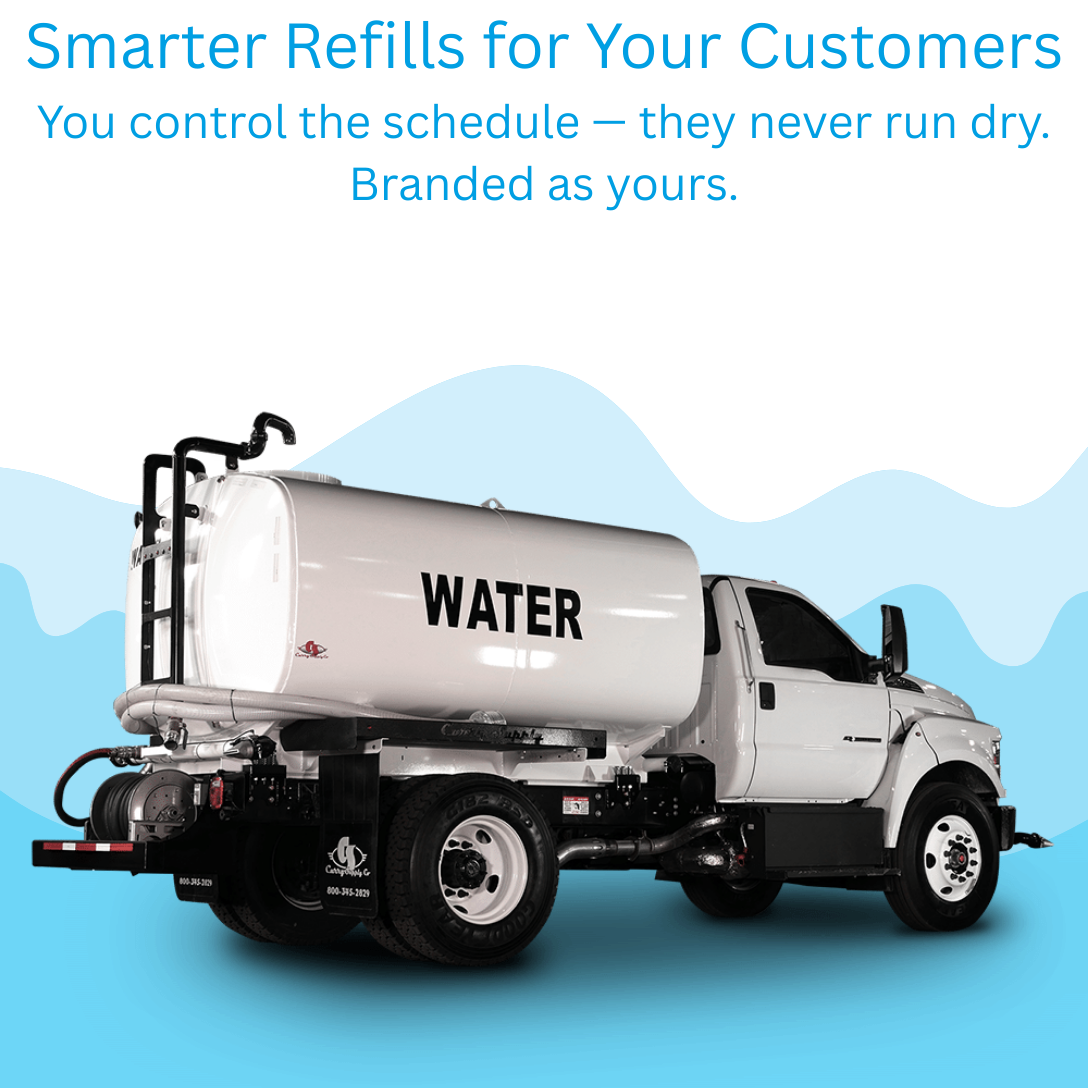
Water cartage businesses and tank-service providers can use remote level monitoring to identify customers approaching a refill point, plan deliveries earlier and offer an ongoing monitoring service rather than waiting for an urgent call.
Smarter Refills for Your Customers
You control the delivery schedule, customers are less likely to run dry, and the monitoring service can be presented under your own brand.
A Managed Refill Service for Customer Tanks
- Customer-specific dashboards: Organise tanks and users by customer, route or service area.
- Refill notifications: Notify the supplier, customer or both when a configured level is reached.
- Delivery planning: Use current levels and recent trends to prioritise upcoming work.
- Reduced emergency demand: Identify developing shortages before the customer runs out.
- Service expansion: Add monitoring to existing delivery, tank-installation or maintenance relationships.
- White-label options: Suitable providers can operate a branded platform and customer environment.
Why Use Telemetry2U for Remote Water Monitoring?
Telemetry2U combines compatible field hardware, multiple wireless network options, configurable dashboards, alerts, historical records and device control in one Australian-hosted platform. Battery and solar-powered options help simplify remote installation, and the system can begin with one tank before expanding across more water assets, sites and users.
Practical to Deploy and Operate
- Straightforward field installation: Battery radar devices mount above the water, while pressure probes can be lowered into position without complex mains or data cabling.
- Preconfigured hardware options: Compatible devices can be tested and prepared for the Telemetry2U account before dispatch.
- Browser-based access and local support: View dashboards from phones, tablets and computers, with project assistance from the Telemetry2U team.
Flexible Across Water Assets and Sites
- Multiple network types: Use LoRaWAN, NB-IoT or LTE-M according to the site and deployment scale.
- More than water level: Add compatible flow, pressure, rainfall, pump status, leak and control inputs.
- Integration options: Use platform APIs and suitable interfaces where data must connect with other operational systems.
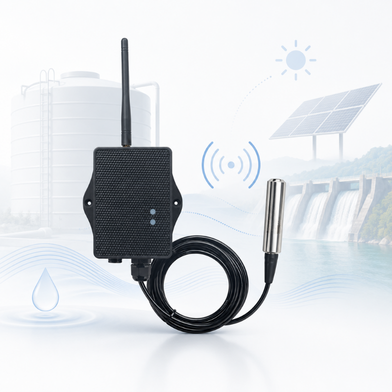
Battery and Solar Options for Straightforward Remote Installation
Many remote tanks and dams can be monitored without installing local mains power or trenching data cables. Battery-operated radar and pressure-monitoring packages suit low-power periodic reporting, while solar-powered versions can support higher reporting rates, additional instruments or compatible control equipment.
Battery life and service intervals depend on the selected hardware and configuration. They should be treated as project design values rather than universal claims.
Related Water Monitoring and IoT Resources
Review the platform features, network guidance and related water applications that support a complete tank, dam, reservoir or water-delivery monitoring project.
Dashboards and Alerts
Configure live views, thresholds, escalation contacts and operational notifications.
Connectivity and Automation
Compare wireless networks and review how compatible controllers can respond to field conditions.
Related Water Applications
Extend the project into flow, leak and water-quality monitoring where those measurements are relevant.
Remote Tank and Dam Level Monitoring FAQ
Answers to common questions about water level sensors, calculated volume, wireless connectivity, alert timing and pump or valve automation.
Remote water level monitoring uses a level sensor, a wireless connection and an online platform to measure and record the level of a tank, dam or reservoir. Users can view current readings, review historical trends and receive notifications when configured conditions are met.
The best sensor depends on the tank design, measurement range, mounting position, liquid conditions and required accuracy. Ultrasonic and radar sensors provide non-contact measurement, while submersible pressure sensors are useful where top mounting is impractical. Float switches are generally used for simple high or low level states rather than continuous measurement.
Yes. Telemetry2U can use the measured level and configured tank geometry to display depth, fill percentage and a calculated volume. The quality of the calculated volume depends on the sensor accuracy, installation and how well the configured dimensions represent the actual tank shape.
Yes, where a suitable sensor and mounting structure can be installed. Open-water monitoring requires assessment of measurement range, sensor blind zone, mounting stability, surface movement, debris, vegetation and flood conditions before the final equipment is selected.
No. Compatible NB-IoT and LTE-M devices connect directly to a supported mobile IoT network and do not require a local LoRaWAN gateway. Coverage must still be checked at the proposed sensor location before installation.
LoRaWAN is often suitable when several tanks, dams, flow meters or related sensors are located across the same property or facility. A correctly positioned gateway can connect many low-power devices, but the radio path and gateway internet connection must be assessed for the site.
The update interval is configured for the device and application. More frequent reporting can provide faster visibility but may increase power and network usage. Battery-powered remote systems are commonly configured for periodic updates and event-based alerts rather than continuous second-by-second transmission.
Yes. Depending on the available measurements and configuration, Telemetry2U can notify selected recipients when a level crosses a threshold or when derived values indicate an abnormal change. Alert delays and escalation rules should be configured to suit the operational risk and normal water-use pattern.
Yes, where compatible control hardware and a suitable automation design are used. Pump and valve control should include appropriate electrical protection, manual override, communication-loss behaviour and fail-safe logic. Telemetry2U does not replace the need for a properly engineered control system.
The platform can show the time of the last received reading and can be configured to identify an extended no-data condition. The response should be defined by the customer, and critical pump or overflow protection should not rely on a cloud connection as the only safeguard.