Water Leak Detection and Level Monitoring with IoT Alerts
Detect water around boilers, purification systems, plant rooms, hospital equipment, mine-site assets and construction services. Telemetry2U connects compatible leak and level sensors through LoRaWAN, NB-IoT or LTE-M to live dashboards, persistent alerts and automated response workflows.
Detect, Escalate and Act Before Water Spreads
Send email, SMS and persistent voice-call notifications, then trigger a compatible solenoid, pump controller, BMS input, siren or strobe when the application requires more than a warning.
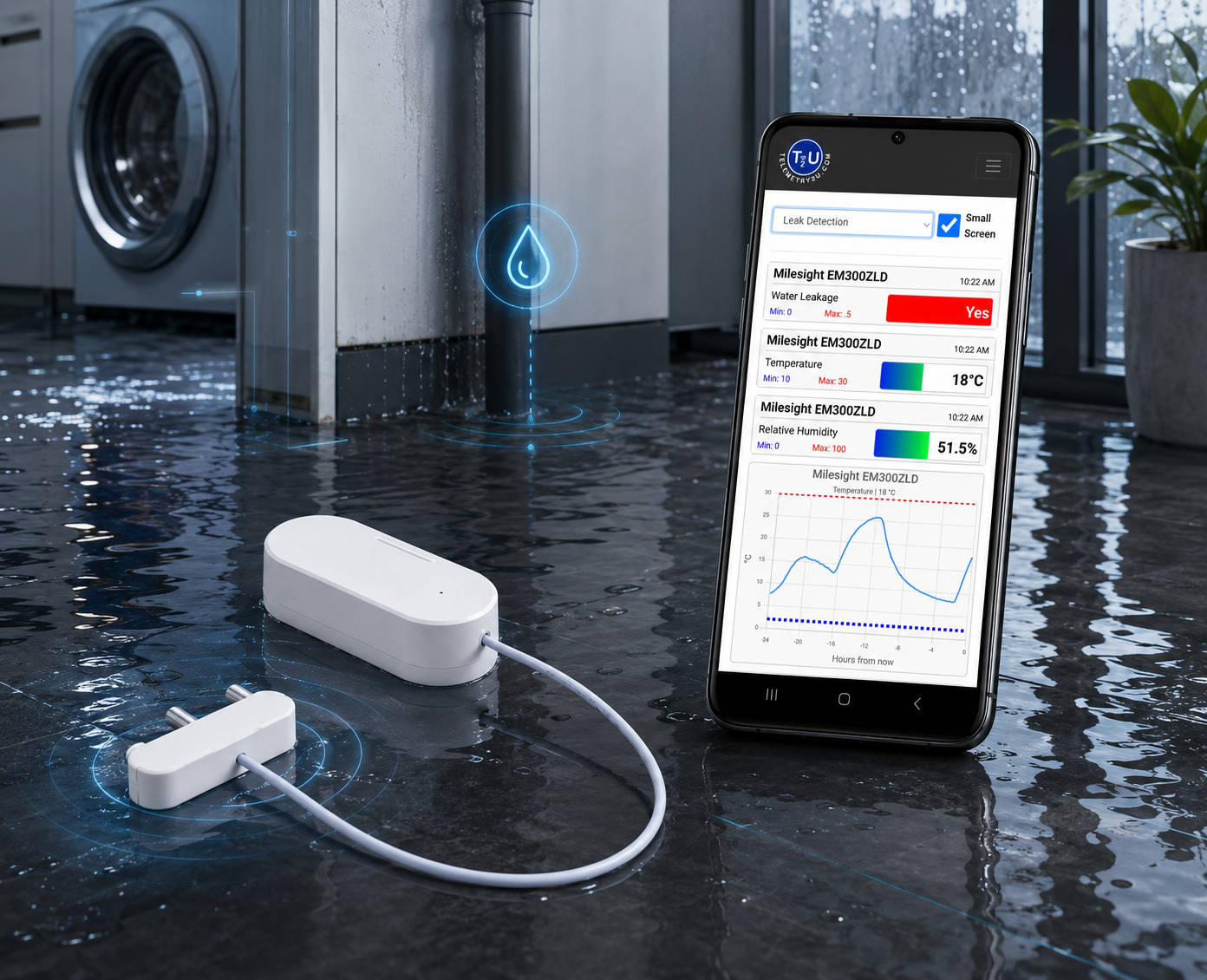
Commercial Water Leak Detection for Critical Rooms and Equipment
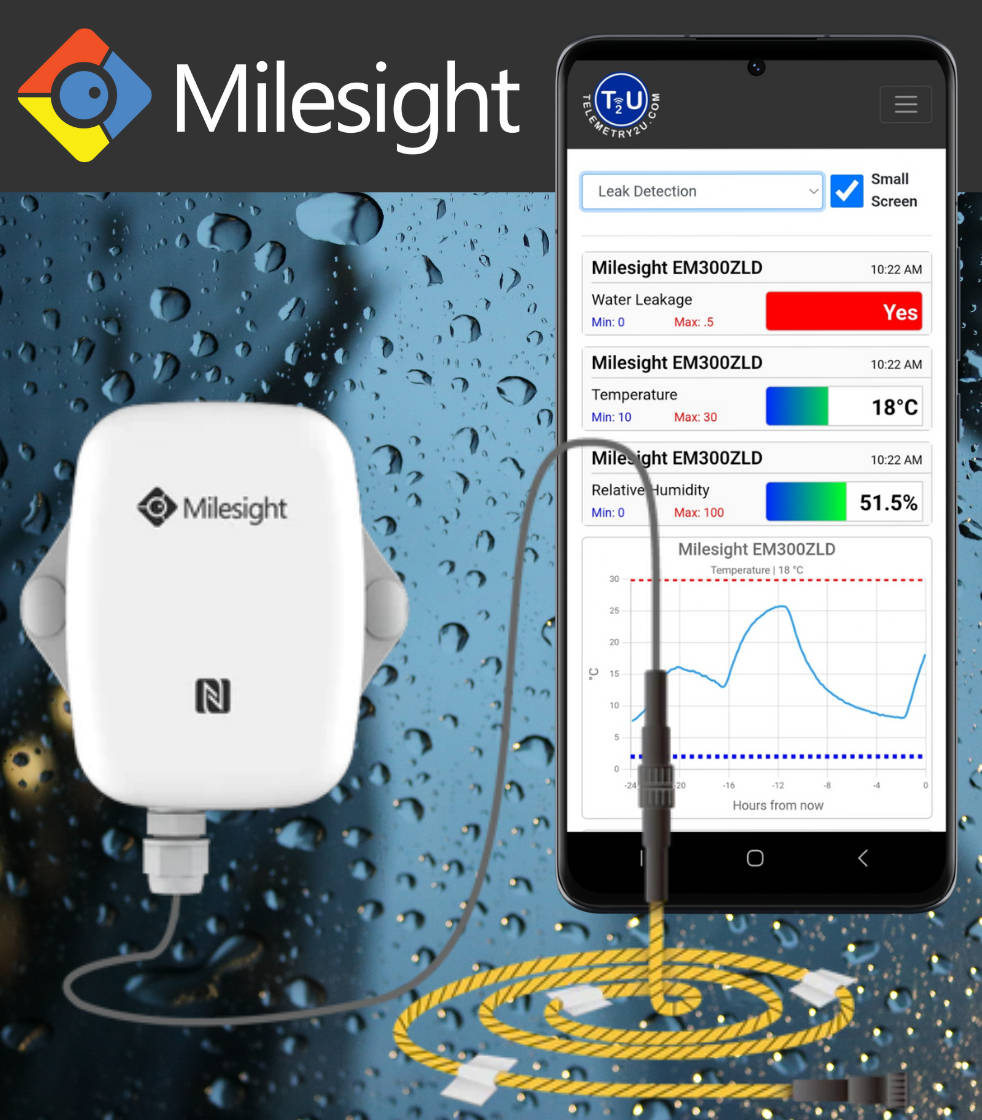
A small leak can become a facilities, safety or continuity problem when it starts beside electrical equipment, above occupied rooms or outside normal working hours. Wireless sensors provide an independent event record and a practical way to notify the people responsible for the response.
Monitor the Event, the Recovery and the Sensor Itself
Telemetry2U can record both the leak event and the return to a dry state. The same platform can show battery condition, communication status and the time of the last successful reading, helping teams distinguish an actual dry condition from a sensor that has stopped reporting.
- Spot and rope detection: Protect one known risk point or cover a longer route around equipment and services.
- Leak and clear events: Record when water appears and when the sensor returns to normal.
- Persistent escalation: Notify nominated staff by email, SMS and acknowledgement-based voice calls.
- Device-health visibility: Review battery, signal and communication status from the same platform.
- Multi-site monitoring: Organise sensors by room, building, project, client or operating site.
- Historical records: Review recurring incidents, response times and event duration.
- Automated response: Trigger compatible relays, controllers and external systems where required.
This application is designed for presence and zone detection at the monitored location. It is different from acoustic pipeline leak-location systems used to find concealed leaks within underground water mains.
Water Leak Monitoring Across Buildings, Industry and Remote Sites
The same platform can support a few high-risk sensors or a distributed network across multiple facilities. Sensor type, enclosure, power and connectivity are selected around the water source, the expected leak path and the response required.
Facilities, Healthcare and Water Systems
Monitor rooms and equipment where an unnoticed leak can damage assets, disrupt operations or affect occupied areas.
Hospitals and Laboratories
Detect leaks around purification systems, analysers, plant rooms, boilers and other water-fed equipment.
Boiler and Mechanical Rooms
Place spot or rope sensors near pumps, valves, heat exchangers and drainage points.
Commercial Buildings
Monitor risers, basements, amenities, kitchens, server rooms and tenant areas from one account.
Water Purification Systems
Combine leak detection with power or inlet-water control for compatible laboratory water systems.
Mine Sites, Construction and Infrastructure
Extend monitoring to dispersed assets where local inspection is infrequent or where normal building Wi-Fi is unavailable.
Mine-Site Water Systems
Monitor pumps, sumps, tanks, treatment equipment and remote service areas using suitable outdoor hardware.
Construction Sewer Stacks and Risers
Track high-level or overflow conditions during construction using compatible level or contact sensors.
Pumps, Sumps and Bunds
Alert when water reaches a nominated point or when level trends indicate a developing problem.
Remote Tanks and Process Water
Combine level, flow and leak status to give operators a more complete view of the water system.
From Water Detection to a Confirmed Response
The strongest leak-detection system is not the sensor alone. It is the complete response path from the first wet contact through notification, escalation, acknowledgement and any approved automated action.
Detect, Notify, Escalate and Act
Detect
A spot, rope or level sensor changes state and transmits the event, together with the available device and battery information.
Notify
Telemetry2U records the event and sends email and SMS notifications to the users or operational groups assigned to the alert.

Escalate
Persistent voice calls can cycle through a priority list until an authorised recipient acknowledges the leak event.

Act
A compatible controller can close a solenoid, stop a pump, signal a BMS or activate a siren or strobe according to the approved design.
Network timing, device class, electrical interfaces and fail-safe behaviour must be considered when an automated action is safety-critical or time-critical.
Choose Spot, Rope or Level Sensors to Match the Water Risk
Leak detection is most effective when the sensing method matches how water is likely to appear. Telemetry2U integrates compatible hardware from multiple manufacturers rather than restricting the deployment to one sensor family.
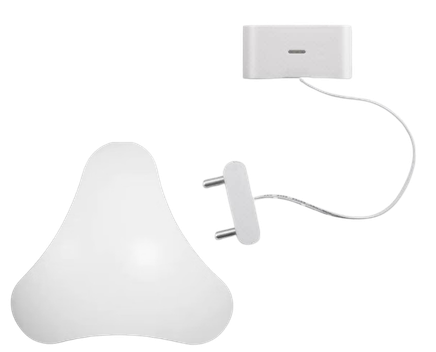
Spot Leak Sensors
Use a compact probe at a known high-risk point such as beneath a purifier, boiler, valve, pump, appliance or pipe connection.
- Simple coverage for a defined location
- Useful in cupboards, cabinets and confined spaces
- Event-driven leak and dry-state reporting
- Battery-powered options for rapid installation
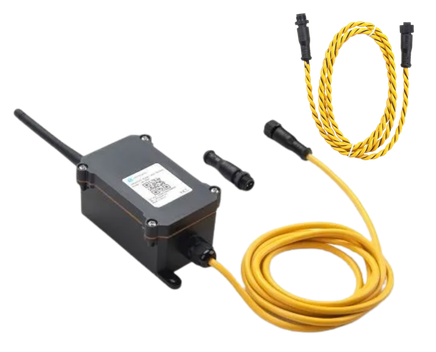
Rope and Zone Leak Sensors
Lay sensing cable around equipment, along a wall or across a floor where the exact point of a future leak cannot be predicted.
- Covers a larger route than a single probe
- Useful around plant, racks and water-fed systems
- Available in indoor and weather-resistant configurations
- Suitable for long rooms and distributed leak paths
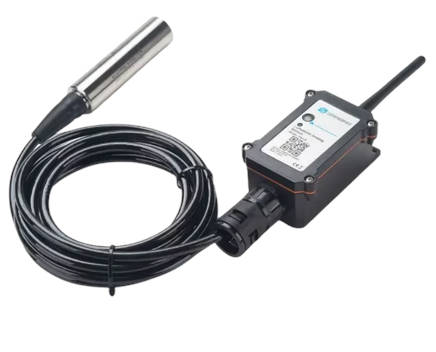
Level and Overflow Sensors
Monitor a continuous liquid level or a nominated high and low point using pressure, ultrasonic, float or contact-based measurements.
- Tank, sump, pit and riser level monitoring
- High-level and overflow notifications
- Historical charts for developing conditions
- Can be combined with flow and pump status
Sensor materials, cable length, enclosure rating, mounting height and liquid compatibility should be confirmed before installation. A water sensor should not be assumed suitable for every chemical or process liquid.
LoRaWAN, NB-IoT and LTE-M for Water Leak Monitoring
The right network depends on sensor density, building layout, existing infrastructure, mobile coverage and how quickly a command must reach the field device. Telemetry2U can manage compatible devices from all three network types in one platform.
LoRaWAN for Buildings and Large Sites
LoRaWAN is practical when many battery-powered leak sensors can share gateway coverage across a hospital, commercial building, industrial facility, campus or mine site.
- One gateway can support many monitoring points
- Long battery life for event-driven sensors
- Useful indoor penetration and broad site coverage

NB-IoT for Stand-Alone Assets
NB-IoT devices connect directly to a supported cellular network, avoiding a local gateway where coverage is available and the site only requires one or a small number of sensors.
- Direct cellular connection without site gateway hardware
- Useful for isolated buildings and remote infrastructure
- Often effective in difficult indoor locations

LTE-M for Distributed Monitoring and Control
LTE-M can support direct cellular monitoring where the selected hardware needs more frequent communication, mobility or remote command features than a basic event-only sensor.
- Direct cellular deployment across separate locations
- Suitable for compatible controllers and richer data exchange
- Can coexist with NB-IoT and LoRaWAN devices in one account

One Platform Across All Three Networks
Leak status, liquid level, water flow, device health and control outputs can be organised in the same dashboards even when the field devices use different wireless networks.
See Leak Status, Water Level and Flow in One Dashboard
One View for Current Conditions and Historical Trends
Combine leak status, tank volume, depth, flow, battery condition and communication health in a dashboard that works across desktop, tablet and mobile.
Investigate the Event, Not Just the Alarm
Current values show what requires attention now. Historical charts and event records help identify when a condition began, how long it lasted and whether a recurring pattern needs further investigation.
- Display wet, dry, high-level and low-level states
- Show tank volume, depth and flow where compatible sensors are connected
- Review historical trends and alert thresholds
- Check battery, signal and last-contact status
- Organise many rooms, buildings and sites in one account
- Use responsive dashboards from a phone during an incident
Telemetry2U operates on Australian-hosted infrastructure, with email, SMS and voice-call notifications integrated into the platform.
Water Leak, Level and Flow Dashboard
Live demonstration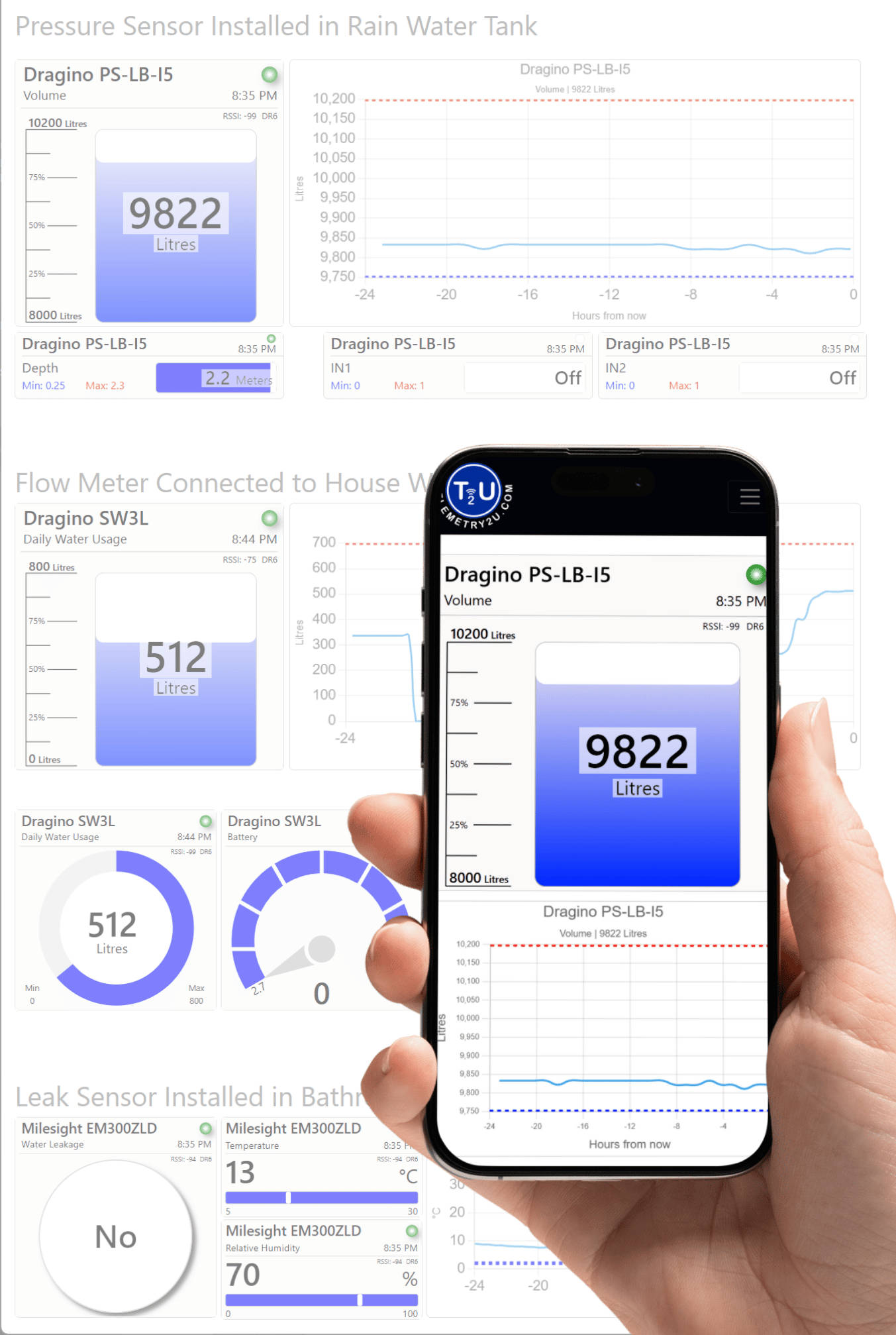
Example dashboard shown for demonstration purposes. Available values, widgets, controls and update intervals depend on the connected devices and configuration.
Plan the Complete Leak Detection Response
Tell us what can leak, where the water is likely to travel, who must be contacted and whether the response should stop equipment, close a valve or signal another system. Telemetry2U can assess the sensor, network, dashboard, escalation and control path as one deployment.
Related Water Monitoring and Automation Resources
Explore the alert, device-control, water-level and hardware pages that support a complete leak detection and response system.
Alerts and Automated Response
Configure notification escalation, device commands and alert-driven actions.

Water and Level Monitoring
Extend the same platform to tanks, dams, water purification and broader water-quality applications.
Dashboards, Networks and Hardware
Review compatible devices, responsive dashboards and the network options available for each site.
Water Leak Detection and Level Monitoring FAQ
Answers to common questions about sensor types, wireless networks, persistent alerts, automated shut-off and dashboard integration.
Spot sensors detect water at a specific high-risk point, while rope or zone sensors cover a longer path around equipment, pipes or plant-room floors. These sensors detect the presence of water or another compatible conductive liquid; they do not locate hidden underground pipe leaks acoustically.
A spot sensor is suited to a small known risk point such as beneath a valve, purifier or boiler. A rope sensor covers a larger route and can be laid around equipment, along a wall or across a plant-room floor. The selected sensor, cable length and installation method should match the likely path of the water.
Yes. Telemetry2U supports compatible leak and level devices using LoRaWAN, NB-IoT and LTE-M. LoRaWAN is often practical where many sensors share site gateway coverage, while direct cellular devices can suit isolated assets or sites without a local LoRaWAN gateway.
An event-driven sensor normally transmits when a leak is detected and again when it clears. The platform processes the received event and sends the configured notifications. Total response time depends on the sensor, wireless coverage, network behaviour and the selected alert workflow.
Voice alerts can be configured to call a priority list and continue cycling through the nominated contacts until an authorised recipient acknowledges the event. Email and SMS notifications can be sent alongside the voice escalation workflow.
Yes, where compatible control hardware and a suitable network design are used. An alert can trigger a relay or controller to close a solenoid valve, stop a pump or operate another output. Response timing and fail-safe requirements must be assessed for the selected device and application.
Yes. A compatible relay, digital output, API or webhook workflow can pass an alarm state to a building management system or activate devices such as a siren or strobe. The electrical interface, command path and required response time should be confirmed during system design.
Yes. A Telemetry2U dashboard can combine compatible leak sensors, pressure or ultrasonic level sensors, float switches and water meters. Users can view current values, historical charts, device health and alert status across one or many locations.