Soil Moisture and EC Monitoring for Smart Farming
Monitor soil moisture, soil temperature and electrical conductivity across crop zones, root depths and farm sites using compatible LoRaWAN, NB-IoT or LTE-M sensors. Telemetry2U brings current readings, historical trends, configurable alerts and device status into one platform.
Use Root-Zone Data to Support Better Irrigation Decisions
See how water moves through the soil profile, compare blocks and depths, identify unusual drying patterns and review soil EC changes without waiting for the next manual inspection.
Monitor Root-Zone Conditions Instead of Relying on Guesswork
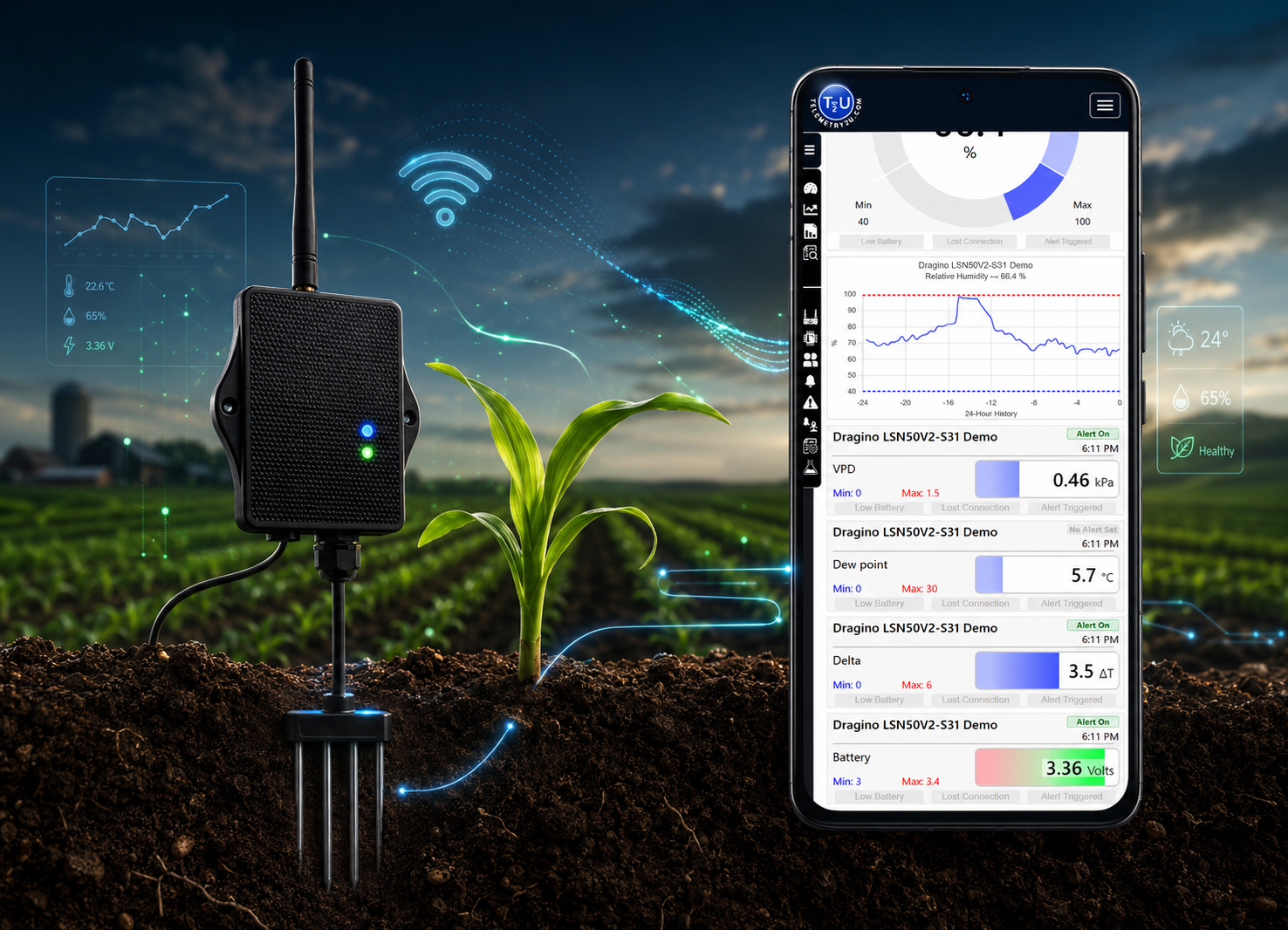
Soil conditions can change substantially between blocks, rows and depths. Continuous wireless monitoring provides a repeatable record of how the root zone responds to irrigation, rainfall, drainage, crop uptake and changing weather.
Soil Moisture, Temperature and EC in One Monitoring Record
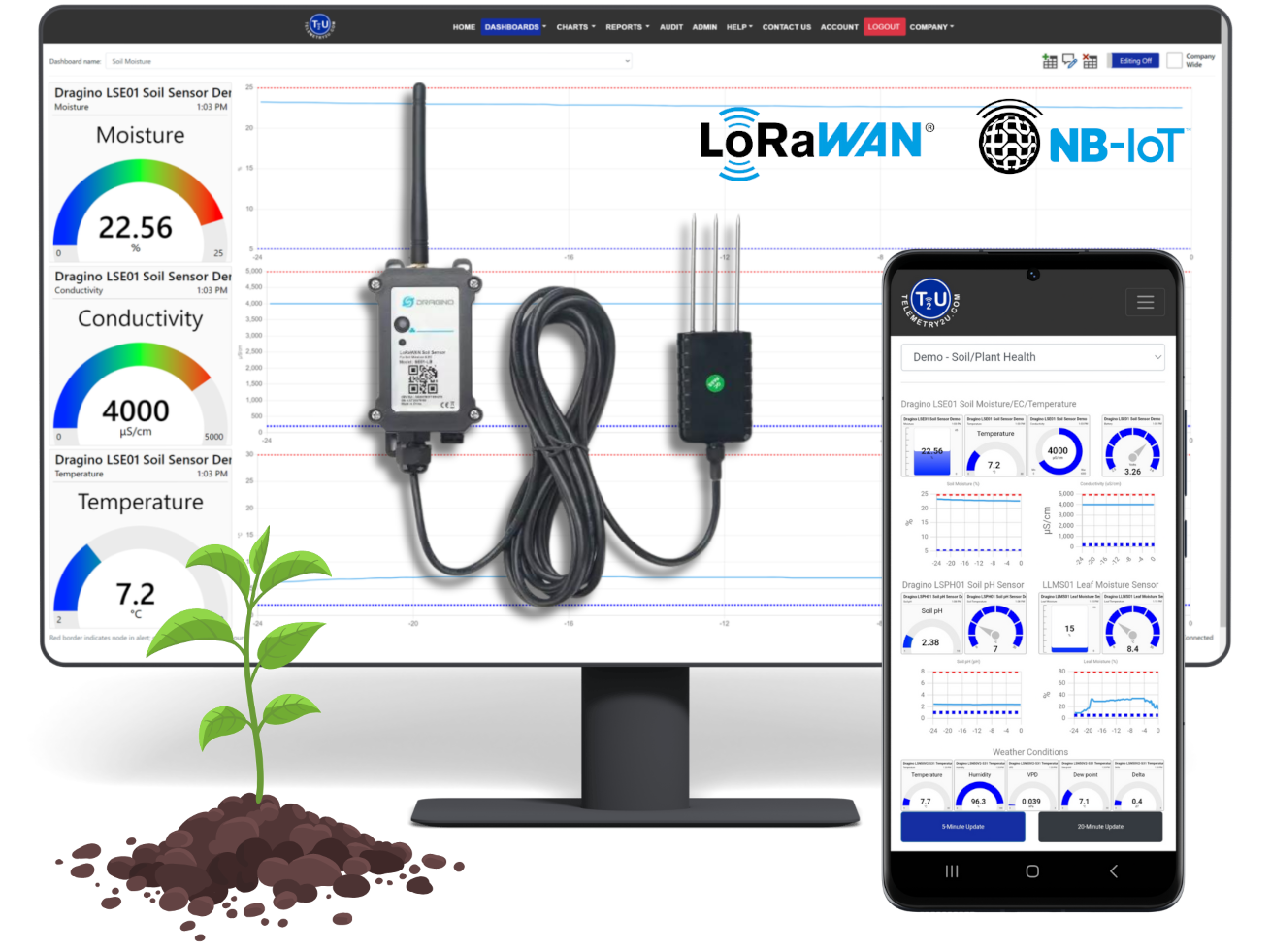
Compatible probes transmit readings at configured intervals. Telemetry2U converts those readings into dashboards, charts, alerts and reports that can be reviewed from a phone, tablet or desktop computer.
- Soil moisture trends: Review wetting, drying and crop-water-use patterns over time.
- Multiple monitoring depths: Compare conditions through the active root zone instead of relying on a single surface reading.
- Soil temperature: Add context to moisture and conductivity data as seasonal conditions change.
- Electrical conductivity: Observe salinity-related and fertiliser-movement trends without treating EC as a direct nutrient test.
- Configurable alerts: Notify nominated users when readings, device health or communications meet selected conditions.
- Historical comparison: Compare crop zones, soil types, irrigation events and growing seasons.
- Device visibility: Review communications status and battery condition alongside the sensor data.
Monitoring does not replace agronomic judgement or appropriate soil testing. It gives growers and irrigation teams a more complete record to use alongside crop stage, weather, soil type and field observations.
See the Soil and Plant Health Monitoring Dashboard
One Dashboard for Root-Zone Conditions and Historical Trends
View current soil readings, charted history, configured limits and device health from one central dashboard. Telemetry2U helps farm teams compare depths and locations without collecting separate manual records from every site.
Turn Individual Readings into Useful Context
A single moisture value rarely explains what is happening across the soil profile. The dashboard makes it easier to compare related measurements, review the period before and after irrigation and identify changes that need closer inspection.
- Display soil moisture, temperature and EC from compatible probes.
- Compare several depths, crop zones, blocks or farm sites.
- Review daily, weekly and seasonal trends around irrigation and rainfall.
- Check alert status, communications health and battery condition.
- Open data tables and reports for deeper review and record keeping.
Soil and Plant Health Dashboard
Live demonstration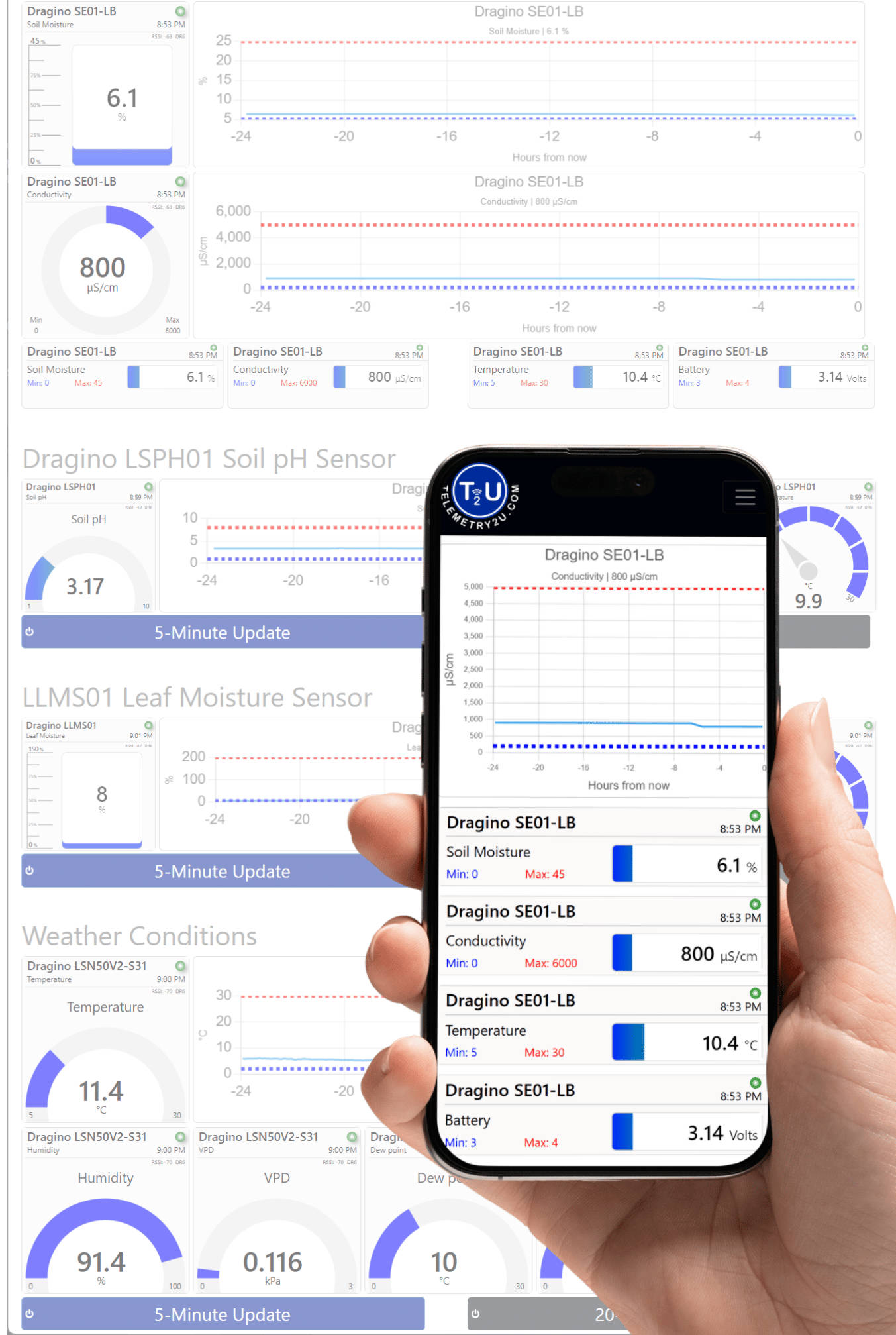
Example dashboard shown for demonstration purposes. Available readings, widgets, alerts and control options depend on the connected devices, configuration and user permissions.
Use Soil Trends to Review Irrigation Performance
Soil monitoring is most useful when the trend is interpreted in context. The aim is not to automate every irrigation decision from one threshold, but to provide evidence about wetting depth, drainage, drying rate and differences between monitored locations.
What the Moisture and EC Trends Can Show
Compare related measurements rather than making decisions from one isolated reading.
Wetting Depth
See which installed depths respond after irrigation or rainfall and how quickly the response occurs.
Drying and Crop Uptake
Review how moisture declines between irrigation events and how the pattern changes through the season.
Drainage Below the Root Zone
Identify deeper moisture responses that may indicate water moving beyond the intended crop root zone.
Conductivity Movement
Compare soil EC changes with moisture, irrigation, rainfall and fertiliser application records.
How Farm Teams Can Use the Monitoring Record
Use dashboards and alerts to focus inspections and support irrigation planning.
Compare Blocks and Zones
Identify locations that dry faster, remain wet longer or respond differently to the same irrigation event.
Verify Water Delivery
Use the soil response with flow, pressure or pump-status data to investigate whether irrigation reached the intended area.
Set Practical Alerts
Notify nominated users when readings, delays or device conditions meet limits selected for the crop and site.
Review Seasonal Performance
Retain a consistent history for comparing irrigation practice, crop stages, soil behaviour and weather conditions.
From Soil Reading to Irrigation Decision
Telemetry2U connects the field measurement to the people responsible for irrigation and crop management. Each stage remains visible, from the sensor reading through to the trend, alert and operational response.
A Practical Soil Monitoring Workflow
Measure
Installed probes measure soil moisture, temperature and conductivity at the selected depths and locations.
Transmit
A compatible LoRaWAN, NB-IoT or LTE-M device sends the readings to Telemetry2U at configured intervals.
Review
Dashboards, historical charts and alerts show how the soil profile is changing and where investigation may be needed.
Act
The responsible team adjusts irrigation, inspects the site or uses compatible control hardware within an approved operating process.
Automated irrigation should not depend on a single cloud reading without suitable safeguards. Critical control designs should retain appropriate local protection, independent limits and a defined response to sensor or communications failure.
Soil Sensor Options for Single Points and Full Root-Zone Profiles
The sensor should match the agronomic question rather than forcing every project into one hardware family. Telemetry2U has integrated cost-effective Dragino soil sensors, multi-depth Sentek profile probes and compatible ICT International instruments so different farms can use the measurement approach that suits the required depths, accuracy, interfaces and deployment budget.
Dragino Soil Sensor Range
Dragino provides practical wireless options for distributed soil moisture, temperature and conductivity monitoring at one or more selected depths.
- SE01: One soil probe for a single monitoring depth or point.
- SE02: Two soil probes for comparing two depths or nearby positions.
- SE0X: A transmitter supporting up to four external soil probes.
- LoRaWAN and cellular variants are available across the wider Dragino range.
Sentek Multi-Depth Profile Probes
Telemetry2U has integrated Sentek profile probes for detailed moisture, temperature and optional salinity monitoring through the active root zone.
- Three-sensor TriSCAN configuration for a 30 cm profile
- Six-sensor TriSCAN configuration for a 60 cm profile
- Twelve-sensor TriSCAN configuration for a 120 cm profile
- Supported integration methods include SDI-12 and suitable Modbus interfaces.

ICT International Sensor Options
Compatible ICT International instruments provide options for commercial irrigation management, environmental monitoring and higher-accuracy research applications.
- Point sensors including MP306, MP406 and SMT100 options
- Multi-depth probes such as the EnviroPro range
- Moisture, temperature and salinity-capable instruments where required
- Integration through supported Modbus, SDI-12, voltage or 4–20 mA interfaces.
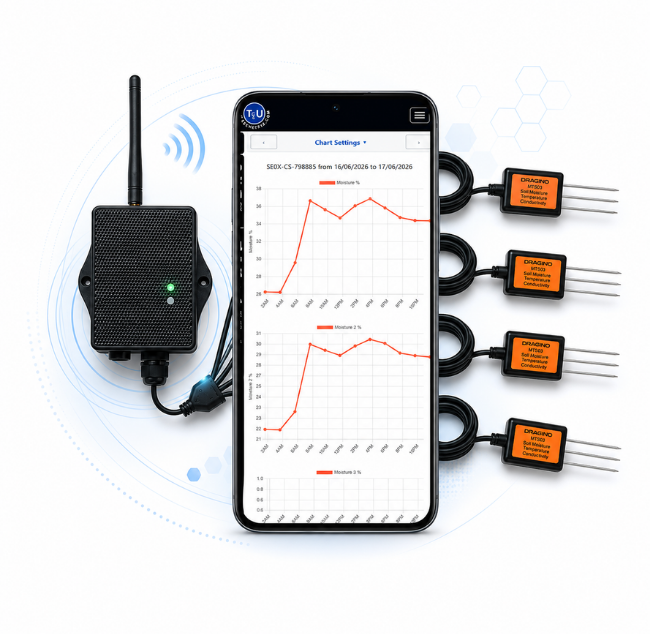
Dragino Probes for Moisture, Temperature and Conductivity
The familiar three-prong Dragino probe is used across the SE01, SE02 and SE0X configurations. The difference between those systems is the number of probes connected to the transmitter, not a different platform for every installation.
- Three related measurements: Soil moisture, soil temperature and electrical conductivity are reported from each connected probe.
- Flexible depth selection: Install probes at depths chosen for the crop, root zone, soil profile and irrigation method.
- Single to four-probe systems: Use one probe for a simple monitoring point or several probes for a more detailed vertical profile.
- Consistent dashboard mapping: Name each input by depth, block, crop or monitoring purpose in Telemetry2U.
- Practical field deployment: Plan cable routes, enclosure position and mechanical protection around cultivation and farm machinery.
Sentek and ICT International sensors can be used when the project needs more measurement depths, different sensing technology, specialist calibration or an interface better suited to an existing installation.
Final selection should consider soil variability, required depth resolution, calibration, expected service life, cable protection, communications coverage, power and the decisions the monitoring record must support.
Choose LoRaWAN, NB-IoT or LTE-M After Selecting the Soil Sensors
Probe selection and network selection are separate design decisions. Choose connectivity according to terrain, vegetation, device count, available cellular service, gateway placement, reporting interval, power and maintenance. Telemetry2U can display compatible devices from all three network families in the same account.
NB-IoT for Fixed Remote Sites
NB-IoT can connect a compatible soil sensor directly through cellular coverage without installing a gateway at the farm.
- Useful for isolated blocks and distributed properties
- Low-power communication for periodic monitoring
- Battery and solar-powered device options
LoRaWAN for Many Sensors Across a Property
LoRaWAN is well suited where many low-power soil, water and farm sensors can share one or more carefully positioned gateways.
- Long-range low-power sensor communication
- One gateway can serve many compatible devices
- Coverage can be extended with planned gateway placement
LTE-M for Direct Cellular Monitoring
LTE-M can support direct cellular soil monitoring where compatible coverage, more frequent communication or wider device capability is required.
- Direct connection without local gateway infrastructure
- Suitable for distributed or changing monitoring locations
- Battery and solar-powered device options
Farm Coverage Must Be Assessed at the Actual Site
Wireless range is affected by terrain, hills, tree crops, buildings, antenna height, gateway location and mobile-network availability. A practical design uses coverage checks and sensible device placement rather than assuming a fixed distance for every farm.
Extend Soil Monitoring Across the Wider Farm System
Soil moisture and EC remain the focus of this page, but irrigation decisions often depend on related water, weather, plant and equipment information. Compatible measurements can be added to the same Telemetry2U account without turning each device into a separate monitoring system.
Soil pH and
NPK
Add compatible soil pH and nutrient-related measurements where the selected sensors and interpretation method suit the application.
Tank and Dam
Levels
Monitor irrigation storage, header tanks, troughs, dams and reservoirs using suitable pressure, ultrasonic or radar level sensors.
Flow and Pump
Operation
Connect compatible flow meters, pulse outputs, pressure sensors and pump-status contacts to verify water delivery and run time.
Weather and Plant
Conditions
Add rainfall, temperature, humidity, wind, leaf wetness and other compatible measurements to provide context for soil trends.
Each additional measurement should answer a defined operational question. A smaller, well-planned sensor network is usually more useful than collecting unrelated data without a clear review or response process.
Plan a Soil Moisture and EC Monitoring System
Tell us which crops, blocks and soil depths need to be monitored, how the irrigation system is arranged, which network coverage is available and whether the devices require battery or solar power. Telemetry2U can help define the probes, transmitters, dashboards, alerts and integration requirements for the deployment.
Related Soil, Irrigation and Smart Farming Resources
Explore related applications, platform functions and hardware used to build a complete farm monitoring system around the soil moisture application.
Farm Monitoring Applications
Review related pages for water storage, crop environments and additional soil measurements.
Dashboards, Alerts and Control
See the platform functions that turn field readings into useful operational information.
Connectivity and Hardware
Compare wireless networks and review the devices and interfaces available for remote farms.
Soil Moisture and EC Monitoring FAQ
Answers to common questions about soil measurements, multi-depth probes, Dragino, Sentek and ICT International sensor options, wireless connectivity and irrigation workflows.
A compatible system can measure soil moisture, soil temperature and electrical conductivity at one or more installed depths. Telemetry2U can display current readings, historical trends, alert limits, communications status and battery condition. The available measurements and accuracy depend on the selected probe, soil type, installation and calibration method.
Multiple depths can show how far irrigation or rainfall has moved through the root zone, whether water is remaining near the surface, how quickly different layers are drying and whether water may be moving below the effective root zone. Probe depths should be selected for the crop, soil profile and irrigation method.
Soil electrical conductivity provides an indication of the soil solution's ability to conduct electricity and can help reveal changes associated with salts, moisture and fertiliser movement. It is useful for comparing trends, but it is not a direct measurement of individual nutrient concentrations and should be interpreted with soil conditions and agronomic context.
Telemetry2U supports Dragino soil monitoring configurations including the SE01 with one probe, the SE02 with two probes and the SE0X transmitter with up to four external probes. The connected probes report soil moisture, soil temperature and soil electrical conductivity. Available LoRaWAN, NB-IoT and LTE-M options depend on the selected Dragino model.
Telemetry2U has integrated Sentek profile probes with three, six and twelve TriSCAN sensing depths, corresponding to common 30 centimetre, 60 centimetre and 120 centimetre configurations. Supported interfaces can include SDI-12 and suitable Modbus arrangements. The exact model, salinity option, interface, power and data mapping must be confirmed before commissioning.
Compatible ICT International soil sensors and profile probes can be integrated when their output and power requirements match a supported interface. Options may include Modbus, SDI-12, voltage and 4–20 mA instruments. The selected sensor, node, measurement mapping, calibration and installation method must be confirmed for the project.
LoRaWAN is often suitable when many low-power sensors can share one or more gateways across a property. NB-IoT and LTE-M can connect compatible devices directly through cellular coverage without a local gateway. The best option depends on terrain, coverage, device count, reporting interval, power, maintenance and the available network service.
Yes. Soil moisture readings can be used for configurable alerts and, with compatible control hardware, selected irrigation commands or automation rules. Control designs should include suitable local safeguards, independent limits and a defined response if a sensor, network or cloud service is unavailable.
Yes. Compatible tank and dam level sensors, flow meters, rain gauges, weather stations, leaf wetness sensors, soil pH instruments and equipment-status inputs can be organised with soil monitoring devices in the same Telemetry2U account. Available dashboards and functions depend on the connected hardware and configuration.