Greenhouse and Hydroponic Monitoring, Alerts and Automation
Monitor greenhouse climate, soil and substrate conditions, hydroponic nutrient solutions, irrigation water and equipment status using compatible LoRaWAN, NB-IoT or LTE-M sensors. Telemetry2U brings live dashboards, historical trends, configurable alerts and selected equipment-control workflows into one platform.
Wireless Monitoring for Soil-Based and Hydroponic Growing Systems
Use long-life battery or solar-powered devices to monitor growing areas, tanks, pumps and irrigation infrastructure without extending data cabling through every greenhouse, room or remote site.
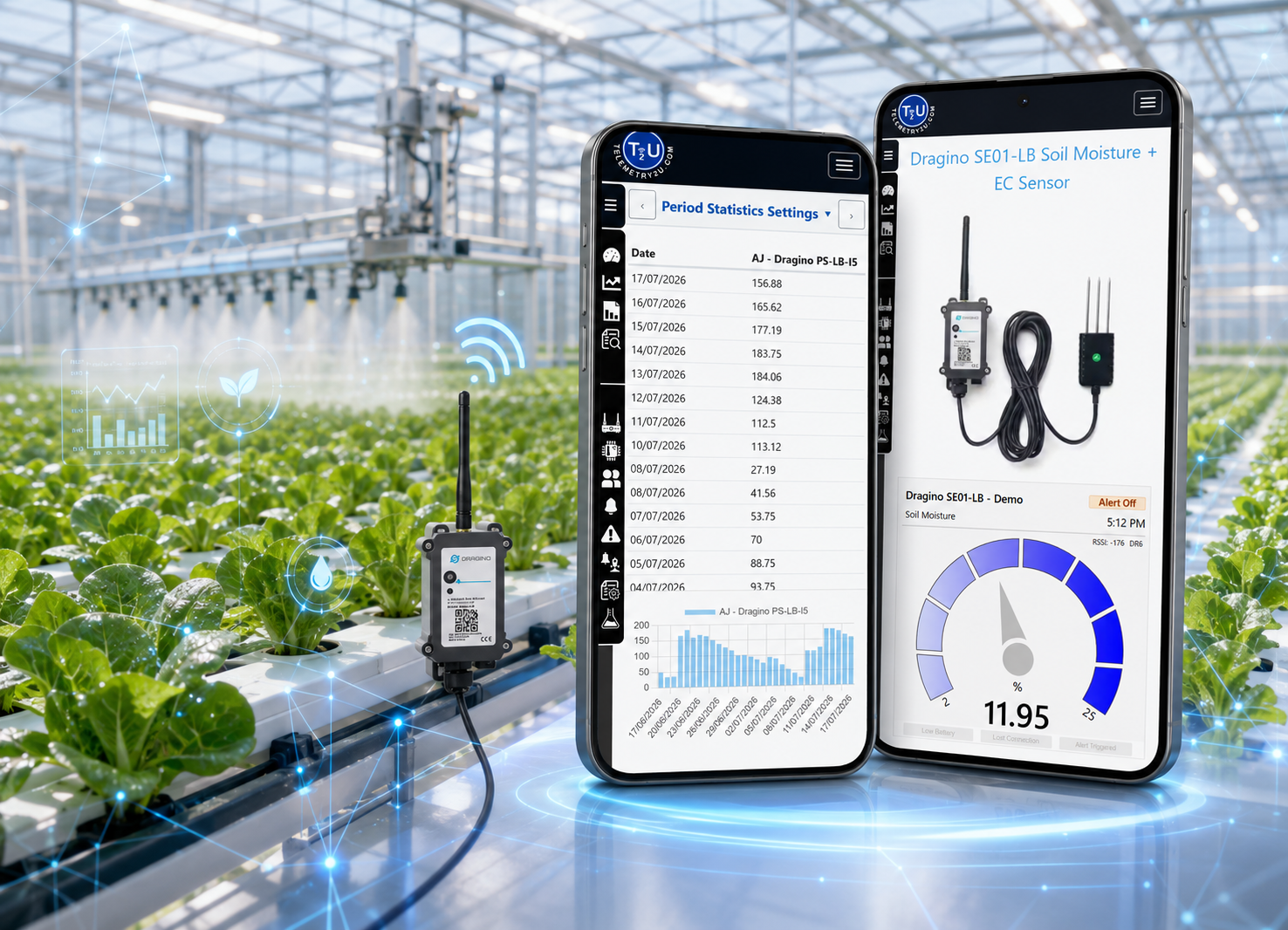
One Monitoring Platform for Greenhouses and Hydroponic Systems
Greenhouses and hydroponic systems use different growing methods, but both depend on stable environmental conditions, reliable water delivery and early warning when equipment or measured values move outside the intended range. Telemetry2U keeps those monitoring records together, whether crops are grown in soil, substrate or recirculating water systems.
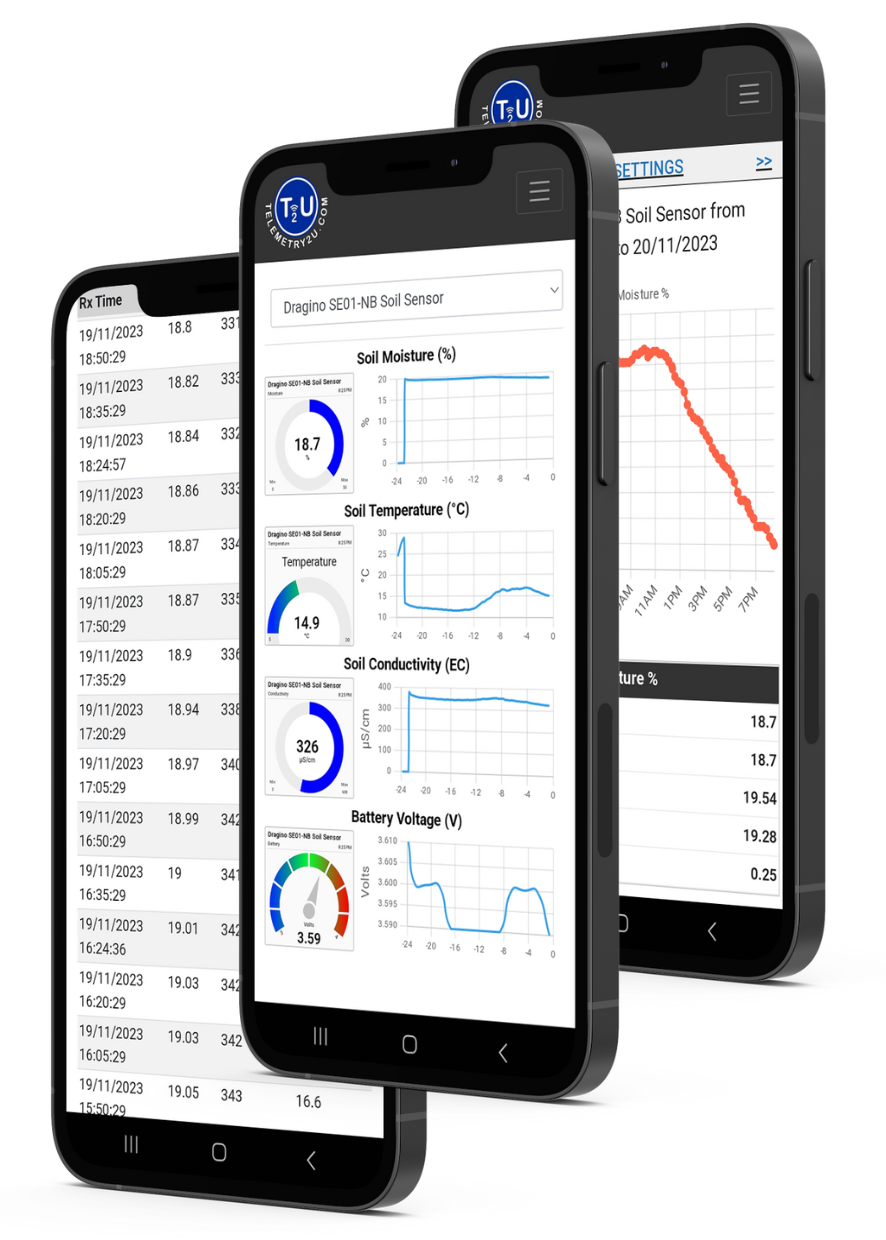
See Conditions, Equipment Status and Water Use Remotely
Suitable sensors send readings to Telemetry2U at configured intervals. Users can review current conditions, compare growing zones, investigate trends and receive alerts without waiting for the next manual inspection.
- Live environmental monitoring: Review air temperature, humidity, CO₂, light and other greenhouse measurements.
- Soil and substrate visibility: Track moisture, temperature, salinity, electrical conductivity and supported soil measurements.
- Hydroponic water monitoring: Display pH, EC, water temperature, dissolved oxygen, level and flow from compatible instruments.
- Configurable alerts: Notify nominated users when readings, device health or equipment status meet configured conditions.
- Equipment status and control: Monitor pumps, valves, fans, heaters, lights and other compatible plant through I/O interfaces.
- Historical records: Compare crop zones, growing rooms, irrigation events and seasonal trends.
- Multi-site operation: Organise devices by farm, greenhouse, room, crop zone or water system.
The same platform can also connect related tank and reservoir level monitoring, water leak detection, real-time pH monitoring and compatible energy or equipment-status devices.
Parameters for Greenhouse and Hydroponic Monitoring
Select measurements according to the crop, growing method, irrigation design and operational risk. A soil-based greenhouse may focus on climate and root-zone conditions, while a hydroponic system may place greater emphasis on nutrient solution, water movement and reservoir status.
Climate, Soil, Substrate, Plant and Irrigation Conditions
Monitor greenhouse climate, root-zone conditions, irrigation performance and crop indicators across soil, substrate and protected-growing zones.
Air and Canopy Environment
Temperature, relative humidity, dew point, vapour pressure deficit, CO₂, light intensity and PAR where suitable sensors are installed.
Root-Zone Conditions
Soil or substrate moisture, temperature, electrical conductivity, salinity and supported pH measurements.
Plant and Disease Indicators
Leaf wetness, temperature and other compatible measurements used to identify changing crop conditions.
Greenhouse Equipment
Pump, fan, heater, light, vent, door, power and dry-contact status from compatible devices and control panels.
Nutrient Solution, Water Delivery and Equipment
Monitor nutrient solution quality, water movement, reservoir conditions and connected equipment across hydroponic and controlled-growing systems.
Nutrient Solution Quality
pH, electrical conductivity, water temperature, dissolved oxygen and other measurements from compatible water-quality instruments.
Reservoir and Tank Conditions
Water level, volume, temperature, refill status and leak detection around tanks, sumps and equipment areas.
Irrigation and Recirculation
Flow, pressure, pump state, valve position, run time and water-use trends where compatible meters and interfaces are fitted.
Growing-Room Environment
Temperature, humidity, CO₂, light and equipment status for indoor farms, propagation rooms and controlled growing spaces.
These measurements are not limited to dedicated Dragino probes. Compatible third-party greenhouse, irrigation and water-quality sensors can often be integrated through dry contact, pulse, 4–20 mA, 0–10 V, RS-485, Modbus or SDI-12 interfaces after compatibility is confirmed.
Alerts, Remote Control and Practical Greenhouse Automation
Telemetry2U can turn sensor readings and equipment states into notifications, remote commands and selected automation workflows. The objective is to help operators recognise changing conditions and respond with the right level of control.
From Detection to Operator Response
Detect
Sensors and equipment interfaces report environmental conditions, water-system values and operational states.
Notify
Configured alerts notify nominated users when limits, delays, device health or equipment states meet the selected conditions.
Review
Operators review the current reading, recent trend, related devices and site context before deciding what action is required.
Control
Compatible controllers can switch or command pumps, valves, fans, lights, heaters and other selected equipment manually, by schedule or through an approved automation rule.
Equipment-control designs should match the process risk. Critical functions should retain suitable local safeguards, independent limits and a defined response if communications or cloud services are unavailable.
LoRaWAN, NB-IoT and LTE-M for Growing Environments
Select connectivity according to site coverage, number of devices, update frequency, power availability and whether a local gateway is practical. Telemetry2U can display compatible devices from all three network families within the same account.
NB-IoT for Fixed Cellular Monitoring
NB-IoT can connect stand-alone sensors directly through a compatible mobile network without installing a local LoRaWAN gateway.
- Suitable for isolated growing sites and distributed assets
- Low-power cellular communication for periodic monitoring
- Battery and solar-powered device options
LoRaWAN for Many Sensors Across a Site
LoRaWAN is well suited where many low-power sensors and interfaces share one or more gateways across greenhouses, sheds and surrounding farm infrastructure.
- Long-range coverage with low device power consumption
- One gateway can serve many compatible monitoring points
- Useful for battery and solar-powered farm deployments
LTE-M for Direct Cellular Connectivity
LTE-M can support direct cellular monitoring where broader data capability, mobility or more frequent communication is required.
- Direct connection without local gateway infrastructure
- Suitable for distributed or changing deployment locations
- Available across modern battery and solar device families
Battery and Solar Power Reduce Installation Constraints
Low-power radios allow many sensors to operate for extended periods without mains power. Solar variants can support outdoor and remote installations where the sensor load, sunlight, battery capacity and reporting interval have been assessed together.
Dragino Sensors and Interfaces for Greenhouse and Hydroponic Monitoring
Current Dragino product families cover soil, plant and water monitoring across LoRaWAN, NB-IoT and LTE-M. Battery and solar-powered variants are available for many outdoor device families, while interface nodes can connect compatible third-party sensors.
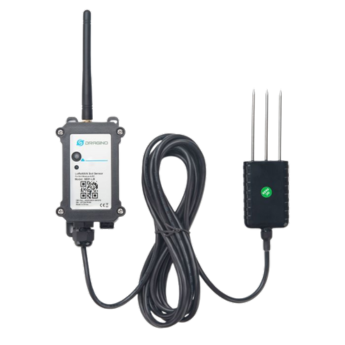
SE01 & SE02 Soil
Moisture and EC
Monitor soil or substrate moisture and electrical conductivity. The SE02 adds a second probe for multi-point or depth comparison.
Networks:
LoRaWAN, NB-IoT and LTE-M
Power:
Battery or solar variants
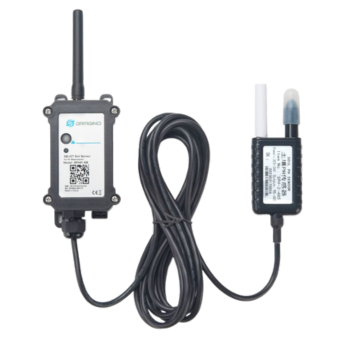
SPH01 Soil pH
Sensor
Track long-term soil pH conditions and trends across greenhouse beds, growing media, agricultural plots and research installations.
Networks:
LoRaWAN, NB-IoT and LTE-M
Power:
Battery or solar variants
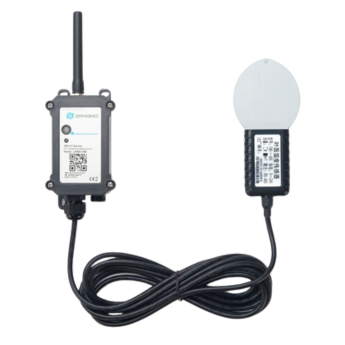
LMS01 Leaf Moisture
Sensor
Monitor leaf moisture and temperature to provide additional context for irrigation, canopy conditions and disease-risk review.
Networks:
LoRaWAN, NB-IoT and LTE-M
Power:
Battery or solar variants
Water Level, Flow
and Pressure
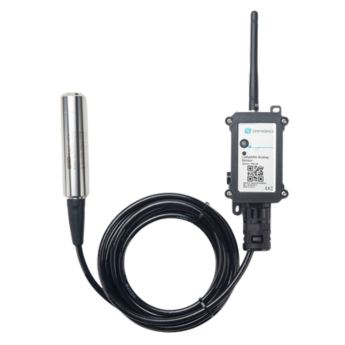
Use PS-Series pressure nodes, SW3L flow sensors and DDS-series level sensors to monitor irrigation pressure, water movement, tank depth and reservoir conditions.
Networks:
LoRaWAN, NB-IoT and LTE-M
Power:
Battery, solar or external
Connect Compatible Third-Party Greenhouse and Hydroponic Sensors
Existing climate sensors, water-quality instruments, flow meters and control panels do not always need to be replaced. Dragino and other compatible interface nodes can bring third-party sensor outputs into Telemetry2U once the electrical interface, power requirements, polling method and data format have been confirmed.
- Analogue signals: Integrate compatible 4–20 mA and supported voltage-output instruments, including 0–10 V devices.
- Digital communications: Connect supported RS-485, Modbus and SDI-12 sensors.
- Status and metering: Monitor dry contacts, pulse outputs and compatible equipment states.
- Flexible deployment: Use LoRaWAN, NB-IoT or LTE-M with battery, solar or external power where supported.
Product selection should be based on the exact measurement range, sensor placement, enclosure, cable length, maintenance requirements, communications coverage and power budget.
See the Greenhouse and Hydroponic Monitoring Dashboard
One Dashboard for Growing Conditions and Equipment Status
View current measurements, historical trends, alert limits and device health from one central dashboard. Telemetry2U helps growers and operators compare crop zones, investigate changing conditions and respond before small problems become larger production issues.
Monitor Greenhouse, Soil and Water Parameters Together
Dashboard content is configured around the connected sensors and the way the site is organised. A single view can combine crop, environmental, irrigation and equipment information without forcing users to check separate systems.
- Review air temperature, humidity, CO₂ and light where compatible sensors are connected.
- Track soil or substrate moisture, temperature, electrical conductivity and supported pH measurements.
- Display leaf moisture, irrigation flow, tank level and compatible water-quality readings.
- Check alert status, communications health and battery condition across monitored devices.
- Compare greenhouses, growing rooms, crop zones and irrigation systems over time.
Plant and Soil Health Dashboard
Live demonstration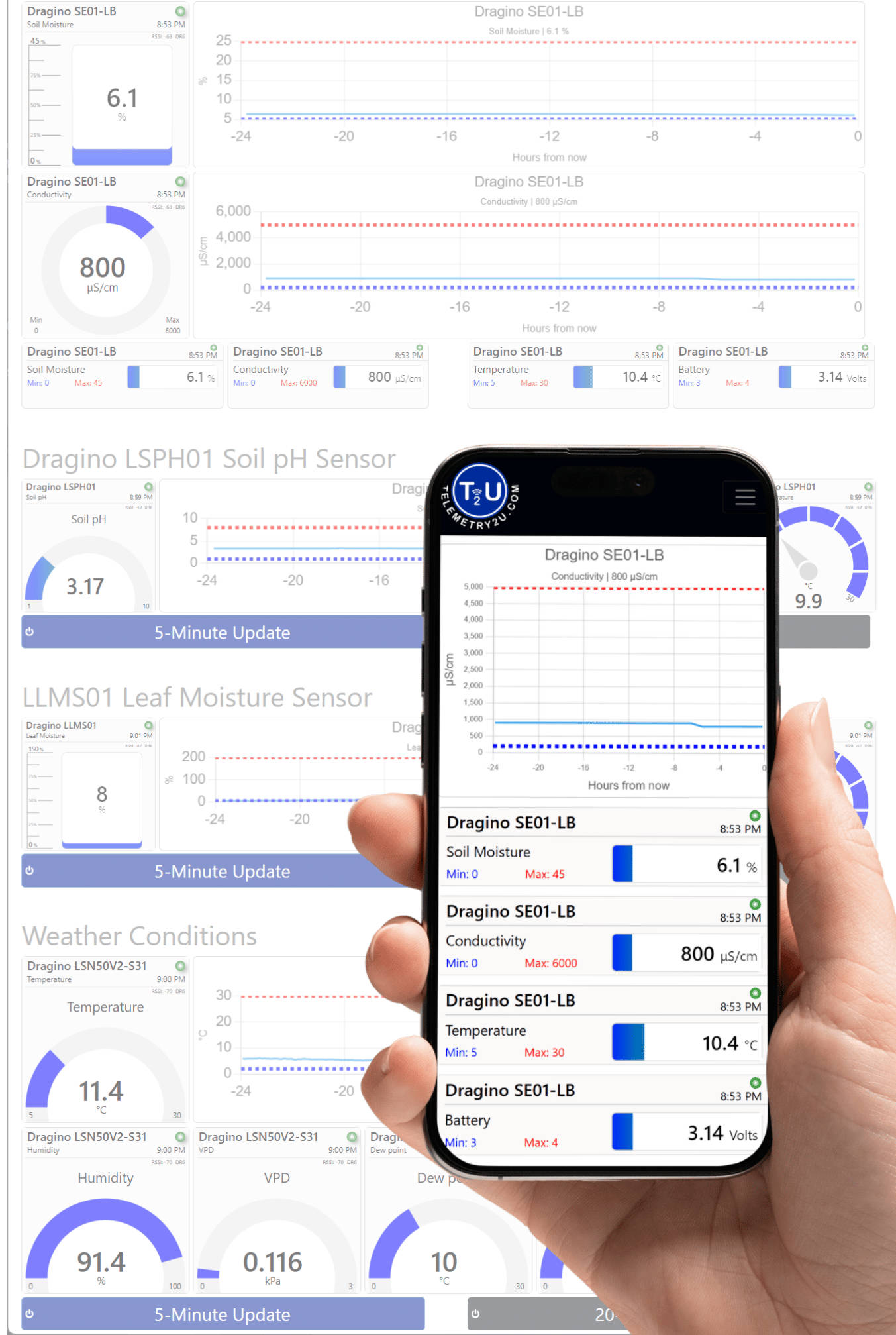
Example dashboard shown for demonstration purposes. Available readings, widgets, alerts and control options depend on the connected devices, configuration and user permissions.
Plan a Greenhouse or Hydroponic Monitoring System
Tell us which conditions and equipment need to be monitored, how the growing areas are arranged, which networks are available and whether the devices require battery, solar or mains power. Telemetry2U can help define the sensors, interfaces, dashboards, alerts and control boundaries for the deployment.
Related Greenhouse, Hydroponic and Irrigation Resources
Explore related monitoring applications, platform functions and hardware used to build a complete growing-environment monitoring system.
Growing and Water Applications
Review related pages for water, pH and wider remote monitoring requirements.
Dashboards, Alerts and Control
See the platform functions that turn sensor readings and equipment states into useful operational information.
Connectivity and Hardware
Compare wireless networks and review battery, solar and general-purpose sensor interfaces.
Greenhouse and Hydroponic Monitoring FAQ
Answers to common questions about measurements, connectivity, alerts, equipment control, battery and solar power, and multi-site deployments.
A suitable system can monitor air temperature, humidity, carbon dioxide, light, soil or substrate moisture, soil electrical conductivity, leaf wetness, nutrient-solution pH and EC, water temperature, dissolved oxygen, tank level, irrigation flow, equipment status and power consumption. The available measurements depend on the selected sensors and installation.
Yes. Telemetry2U can bring compatible LoRaWAN, NB-IoT and LTE-M devices into the same platform. LoRaWAN is often suitable where many sensors share a gateway, while NB-IoT and LTE-M can connect distributed sites directly through a compatible cellular service.
Yes. Many low-power sensors are available in long-life battery and solar-powered variants. The appropriate option depends on sensor power demand, reporting frequency, radio coverage, available sunlight and the maintenance interval required for the site.
Users can configure high, low and status-based alert conditions, notification delays, recipients and escalation rules. When a configured condition is met, Telemetry2U records the event and sends notifications through the channels enabled for the account.
Compatible I/O controllers can provide remote commands, schedules and selected sensor-based automation for equipment such as irrigation pumps, valves, fans, lights and heaters. The control design should match the process risk, and critical functions should retain appropriate local safeguards and independent protection.
Often, yes. Telemetry2U can integrate compatible third-party sensors through interfaces such as dry contact, pulse, 4–20 mA, supported voltage inputs including 0–10 V, RS-485, Modbus and SDI-12. The sensor output, power requirements, polling method and data format must be confirmed before commissioning.
Dashboards can display current readings, minimum and maximum limits, historical charts, device status, battery condition, irrigation flow, tank level and other configured measurements. Users can also review data tables, alerts and reports from desktop or mobile devices.
Yes. Devices can be organised by site, greenhouse, growing room, crop zone or water system. User access and notifications can then be configured for the locations and equipment relevant to each person or team.