Real-Time pH Monitoring with Calibration-Free Solid-State Sensors
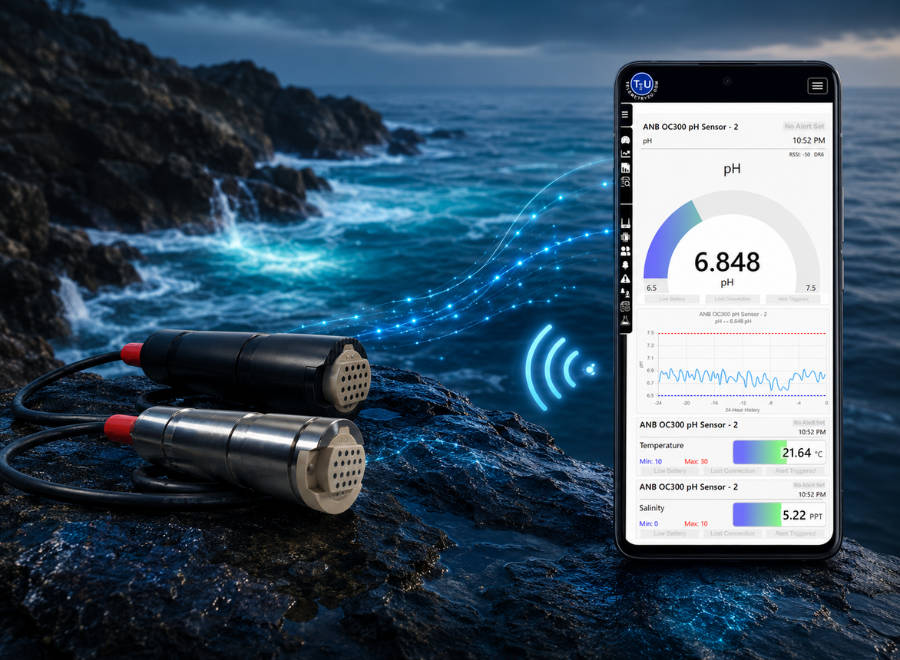
Connect compatible ANB calibration-free pH sensors to Telemetry2U using LoRaWAN, NB-IoT or LTE-M. View pH and temperature data in live dashboards, configure alerts, review historical trends and support remote battery or solar-powered monitoring sites.
Keep the Sensor. Add the Telemetry Layer.
Telemetry2U connects the sensor, field interface, wireless network and cloud platform so pH data can be reviewed away from the monitoring site.
Continuous pH Data Without Routine Buffer Calibration
Manual sampling remains useful for verification, but it only captures water conditions at one moment. Real-time pH monitoring shows how acidity and alkalinity change between site visits, overnight and during weather, treatment, feeding or process events.
See pH Changes as They Develop
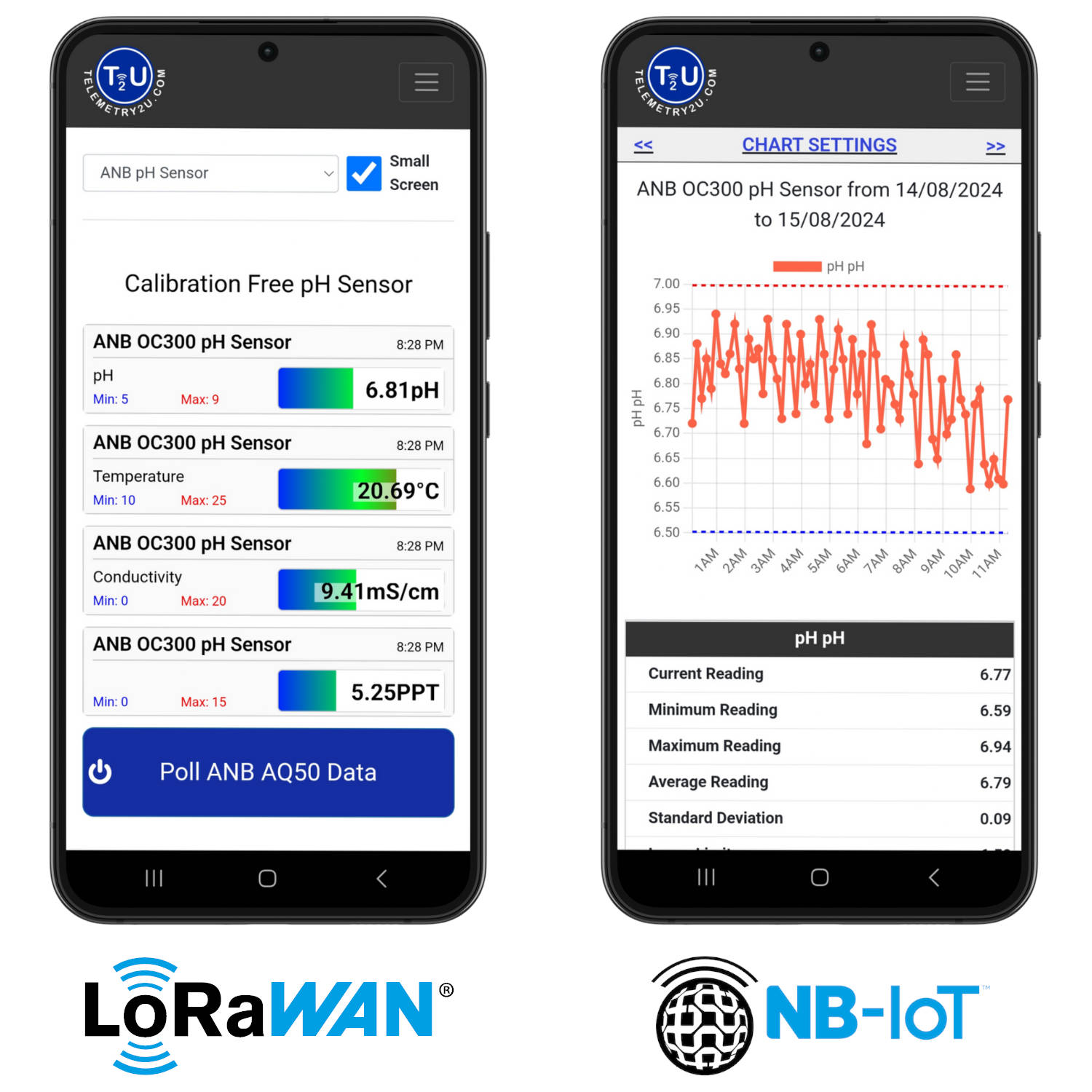
Telemetry2U gives operators, researchers and technical teams a central view of compatible ANB pH sensors. Readings can be transmitted at the configured interval, retained for historical analysis and compared with alert thresholds without relying on someone being physically present.
- Live pH and temperature readings: View current values from authorised internet-connected devices.
- Historical pH trends: Review changes before, during and after environmental or process events.
- Threshold alerts: Notify selected users when pH moves outside configured limits.
- Multi-site visibility: Organise monitoring points across tanks, ponds, rivers, farms and research sites.
- Device-status information: Review the latest transmission, communication status and available sensor-health values.
- Remote polling and control: Issue supported device commands where the integration has been configured for them.
- Calibration-free operation: Remove routine manual buffer calibration while retaining the manufacturer's low-maintenance requirements.
This specialist pH monitoring application can operate independently or form part of a broader aquaculture water quality monitoring system or oceanographic instrument integration .
What Calibration-Free Solid-State pH Monitoring Changes
ANB's solid-state technology is designed for long-term water monitoring without routine manual calibration against pH buffer solutions. It reduces a recurring field task, but it does not remove the need for correct deployment, inspection and manufacturer-specified transducer maintenance.
Calibration-Free Does Not Mean Maintenance-Free
The sensor self-calibrates in situ, while a health value helps indicate when the replaceable transducer requires attention.
No Routine Buffer Calibration
The sensor compensates for reference changes internally instead of requiring regular manual calibration in standard solutions.
Solid-State Construction
The design removes the fragile glass electrode used by conventional probes and can be stored wet or dry.
Sensor Health Feedback
Available health information helps operators identify when transducer abrasion or replacement is required.
Low-Maintenance Field Operation
Maintenance intervals depend on measurement frequency and conditions, so the deployment plan should include inspection and service access.
Built for Freshwater, Marine and Process Deployments
The current AQ² range combines pH sensing with digital interfaces and depth options for different water-monitoring environments.
pH and Temperature
ANB sensors provide pH and temperature. Conductivity and salinity outputs depend on the selected model and operating conditions.
Documented Digital Communications
AQ² supports RS-232, RS-485 and Modbus RTU, creating practical options for third-party telemetry integration.
Multiple Depth Ratings
Current models are available for nominal 5 m, 50 m, 300 m and 1,250 m deployment depths.
Application-Specific Selection
The required pH range, depth, housing, communications, power supply and measurement schedule should be confirmed before configuration.
How Real-Time pH Monitoring Reaches the Cloud
The sensor, telemetry interface, wireless network and cloud platform remain separate, serviceable components. This allows a suitable field instrument to be retained while its data becomes remotely accessible.
From pH Measurement to Actionable Alert
Measure
The solid-state sensor measures pH, temperature and any other supported outputs at the configured interval.

Connect
A compatible RS-485 or Modbus interface polls the sensor, applies the command sequence and prepares the response.

Transmit
LoRaWAN, NB-IoT or LTE-M carries the decoded readings from the monitoring site to Telemetry2U.

Monitor
Dashboards, trends, alerts and historical records turn raw pH readings into information the team can use.
LoRaWAN, NB-IoT and LTE-M for Wireless pH Monitoring
Network selection should follow the monitoring site, not the other way around. Telemetry2U supports LoRaWAN, NB-IoT and LTE-M so the pH sensor can use a private long-range network or direct cellular connection according to coverage, power and reporting requirements.

NB-IoT for Fixed Remote Monitoring Points
NB-IoT connects a compatible interface directly to a carrier network without a local gateway.
- Direct SIM-based connection
- Useful for distributed fixed monitoring sites
- Coverage must be confirmed at the installation point

LoRaWAN for Sensor Networks and Field Sites
LoRaWAN is well suited to sites where one gateway can support multiple monitoring points over a private long-range network.
- One gateway can support many compatible devices
- Low-data-rate, long-range communication
- Gateway placement and radio coverage require planning

LTE-M for Direct Cellular Monitoring
LTE-M can suit sites needing direct cellular communication, more frequent updates or lower latency than a typical NB-IoT deployment.
- No local LoRaWAN gateway required
- Useful for geographically dispersed monitoring assets
- Power demand and carrier coverage must be assessed

One Platform Across Private and Cellular Networks
LoRaWAN, NB-IoT and LTE-M devices can be organised together in Telemetry2U, allowing different sites to use the most suitable network without separating their dashboards, alerts and historical data.
ANB Sensor Technology, Supplied with Specialist Local Support
ANB develops the calibration-free solid-state pH sensor. Imbros provides specialist marine and laboratory instrumentation support in Australia. Telemetry2U adds the compatible telemetry interface, wireless network and cloud platform.
Calibration-Free pH Sensors from ANB
The current AQ² range is designed for long-term freshwater, marine, aquaculture, environmental and process monitoring. Telemetry2U can assess the sensor communications, polling method, power budget and required dashboard outputs for a suitable integration.

Working with Imbros
Telemetry2U works directly with Imbros to help customers select suitable marine and laboratory instrumentation and connect compatible equipment to remote dashboards, alerts and historical records.

Sensor, Wireless Interface and Solar Power for Remote pH Monitoring
A reliable installation depends on more than the pH sensor. The communications interface, power system, enclosure, reporting schedule and site access must be designed together. Telemetry2U can supply pre-configured field hardware for suitable fixed and off-grid deployments.
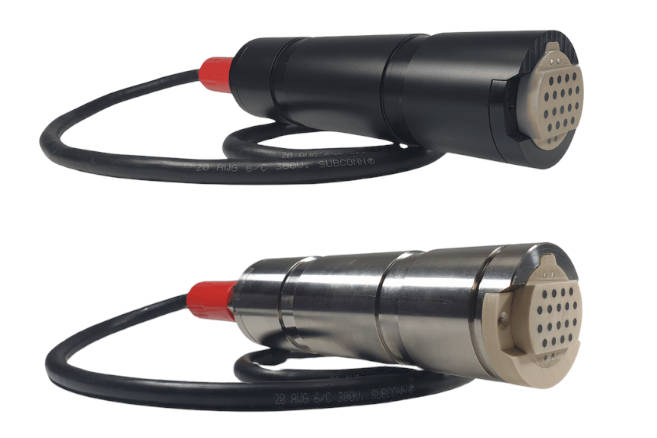
1. Calibration-Free pH Sensor
Select the ANB model around depth, housing, water conditions, communications and measurement requirements.
- pH and temperature measurement
- RS-232, RS-485 and Modbus RTU options
- Freshwater and seawater deployment
- Low-maintenance replaceable transducer
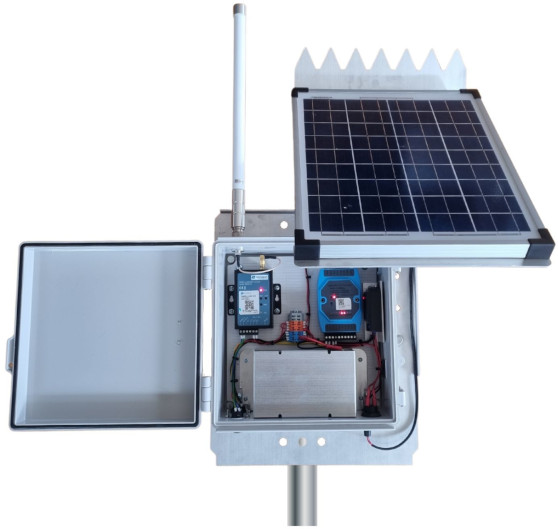
2. Solar Sensor Interface Kit
The pole-mounted solar kit provides battery storage, charge control and a weatherproof enclosure for remote monitoring equipment.
- 20 W solar panel and 12 V battery
- IP67 weatherproof enclosure
- Space for a compatible RS-485 interface
- Suitable for assessed LoRaWAN or cellular deployments
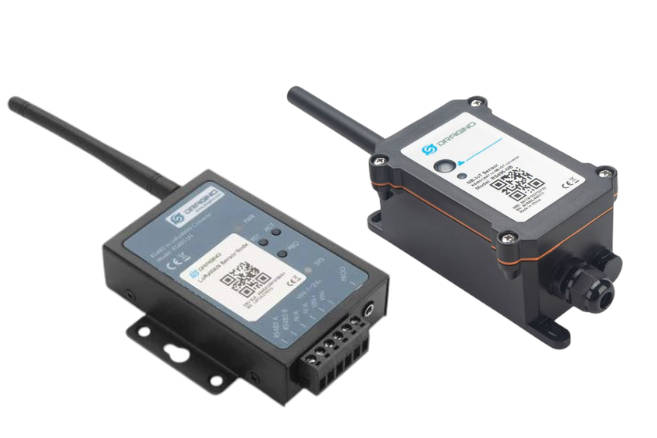
3. RS-485 Telemetry Interface
A compatible Dragino interface polls the sensor, manages the command timing and transmits the selected measurements.
- LoRaWAN, NB-IoT and LTE-M model options
- Configurable Modbus command sets
- Payload decoding for selected readings
- Pre-configuration before field installation
Solar capacity must be assessed against sensor current, warm-up time, reporting interval, local sunlight, battery autonomy and network behaviour. A remote system should not be sized from panel wattage alone.
See Real-Time pH Data in the Telemetry2U Dashboard
One Dashboard for Live pH and Historical Trends
View current pH, temperature, historical charts, alert status and device information from one central dashboard. Available widgets depend on the connected sensor and the configured decoder.
Review Conditions Before and After an Event
Historical charts help teams examine when a pH change began, how long it lasted and whether conditions returned to the expected range. The same dashboard can combine pH with compatible water-quality and oceanographic instruments.
- View current pH and temperature readings
- Examine trends over selected time periods
- Identify high and low threshold breaches
- Review communication status and the latest successful reading
- Display supported sensor-health or status values
- Organise multiple monitoring sites in one account
pH and Oceanography Dashboard
Example configuration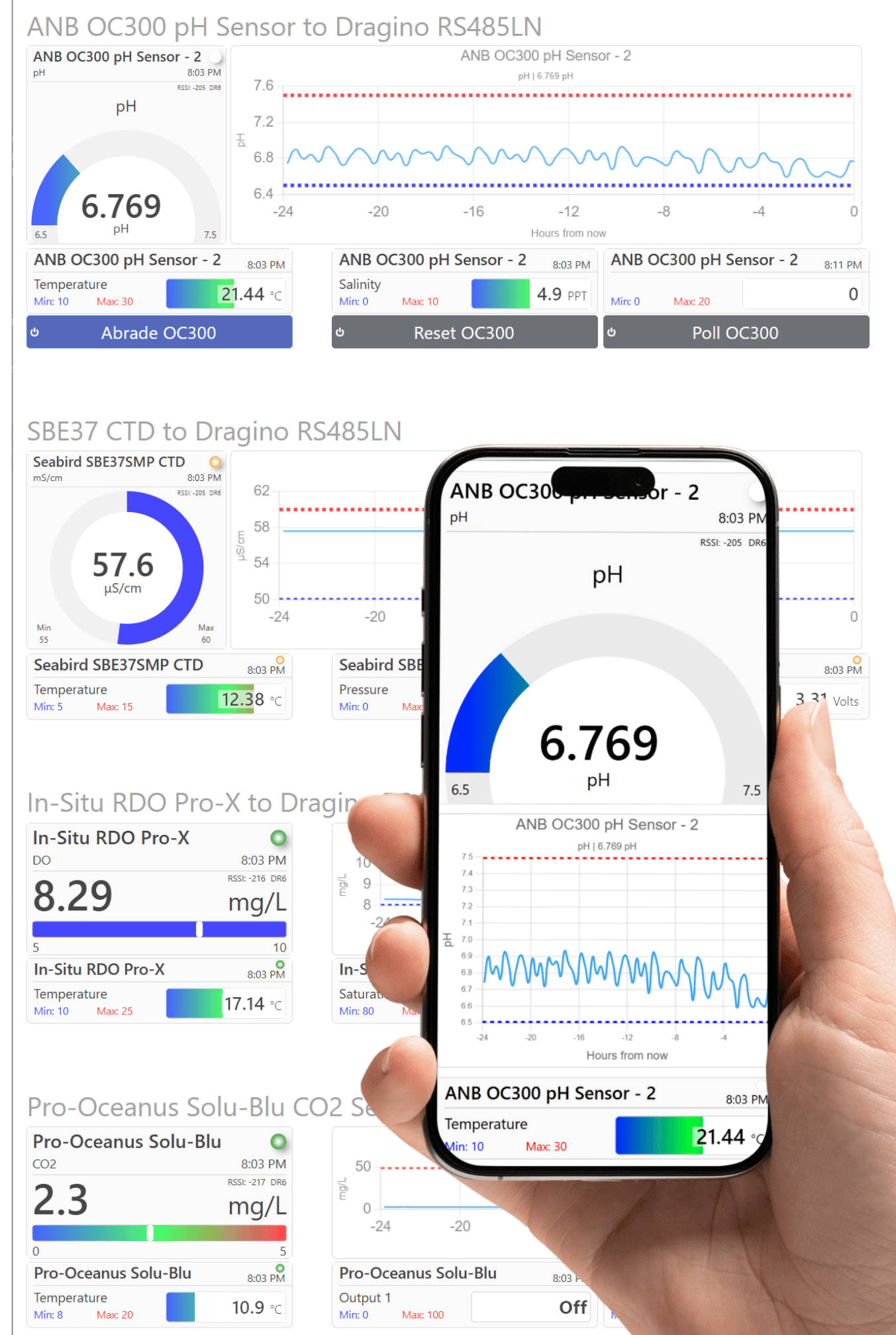
Example dashboard shown for demonstration purposes. Measurements, commands, widgets and reporting options depend on the connected instruments and configuration.
Discuss a Calibration-Free pH Monitoring Deployment
Tell us which ANB sensor you are using, where it will be installed, how often readings are required and which wireless networks are available. Telemetry2U can assess the interface, power system, decoder, dashboard and alert configuration.
ANB pH Sensor Integration Using Modbus and Dragino RS-485 Hardware
The configuration below preserves Telemetry2U's existing ANB OC300 and Dragino integration example. It is useful as a practical reference, but the current sensor manual, register map, firmware, electrical design and command syntax must be verified before commissioning an AQ², OC300 or other ANB model.
Configure the Existing ANB OC300 Example
The original integration uses the following OC300 settings as its starting point:
- Serial connection: 57600 baud, 8 data bits, no parity and 1 stop bit.
- Deployment interface: Select Modbus and use the configured device address, shown here as
0x55. - Operating mode: Controlled Mode.
- Power option: Always Powered in the preserved example.
- Interval delay: 60 minutes, matched to the Dragino transmit interval.
- Measurement delay: No additional sensor delay.
- Profiling mode: Disabled for this fixed monitoring configuration.
Sensor stabilisation, warm-up and measurement timing must be considered when changing the interval or power-control strategy.
Configure the Dragino RS-485 Interface
The Dragino interface is configured to run the sensor command sequence, wait for the required measurement period, read the selected registers and transmit the decoded values to Telemetry2U.
- Connect to the Dragino device using the supported USB, serial or Bluetooth configuration method.
- Set the serial baud rate with .
- Program the four-command sequence shown in the table below.
- For the preserved example, set the transmit interval to 60 minutes with .
- Confirm the correct Telemetry2U decoder and input mapping before relying on the displayed values.
Command availability and syntax vary between Dragino model families and firmware versions. Use the documentation supplied with the installed hardware.
Dragino Command Set for ANB pH Sensor Integration
Tap or click any code value to copy it to the clipboard.
| Function | Command | Data Cut | Delay |
|---|---|---|---|
| 40-Second Delay | |||
| Start Scan & Wait 4 Minutes | |||
| Bulk Read | |||
| Stop Scan |
Dragino Command Set for ANB pH Sensor Integration
Command 1: 40-second delay, Command 2: start scan and wait four minutes, Command 3: read data from bytes 4–21 and Command 4: stop the scan.
Add the Dragino device to Telemetry2U, select the ANB pH Sensor V1.0 decoder and confirm each displayed value against the installed sensor before the monitoring system is commissioned.
Related pH Monitoring and Water Quality Resources
Explore related monitoring applications, platform features, wireless-network guidance and hardware used to build a complete remote pH monitoring system.
Water Monitoring Applications
See how pH monitoring fits into wider aquaculture, marine and environmental systems.
Dashboards, Alerts and Data
Review the platform functions that turn pH readings into usable operational information.
Connectivity & Hardware
Compare networks and review the hardware used to connect digital water-quality instruments.
Real-Time and Calibration-Free pH Monitoring FAQ
Answers to common questions about solid-state pH sensors, maintenance, wireless connectivity, solar power and Telemetry2U integration.
Calibration-free pH monitoring uses a sensor that compensates for reference changes in situ, removing the routine manual buffer-calibration process required by conventional glass-electrode probes. The sensor still requires appropriate installation, periodic inspection and the maintenance specified by its manufacturer.
Yes. ANB sensors do not require routine manual pH-buffer calibration, but they are low-maintenance rather than maintenance-free. The transducer surface requires periodic abrasion when indicated by the sensor health value, and the replaceable transducer eventually reaches the end of its service life.
ANB sensors provide pH and temperature measurements. Conductivity and salinity availability depends on the sensor model and operating conditions, so the required outputs should be confirmed for the selected instrument and deployment.
Yes. A compatible RS-485 or Modbus interface can connect the sensor through LoRaWAN, NB-IoT or LTE-M hardware. The best network depends on site coverage, gateway availability, update frequency, power supply and the number of monitoring points.
Yes. Remote deployments can use a weatherproof solar sensor interface with battery storage where the sensor power demand, reporting interval, communications coverage and available sunlight have been assessed together.
Users can configure high and low pH thresholds, alert delays, notification recipients and escalation rules. When the configured condition is met, Telemetry2U records the event and sends notifications through the alert channels enabled for the account.
Yes. Telemetry2U has an existing ANB OC300 integration using Modbus RTU and Dragino RS-485 hardware. The sensor settings, register map, command syntax, firmware and power design should be verified for each installation before commissioning.
Imbros supplies specialist marine and laboratory instrumentation, including ANB sensor products. Telemetry2U provides the compatible telemetry interface, wireless connectivity, dashboard configuration, alerts and historical data platform for suitable monitoring deployments.