Wine Cellar Temperature & Humidity Monitoring
Monitor wine cellars, winery storage rooms and barrel areas with distributed temperature and humidity sensors, live dashboards and long-term environmental records. Telemetry2U combines practical LoRaWAN hardware with historical analysis, configurable alerts and a platform that can grow from one cellar to multiple sites.
See More Than a Single Cellar Reading
Compare conditions between racks, heights, rooms and buildings to understand temperature and humidity variation over hours, seasons and years. Start with a few sensors and expand the same monitoring system as your collection or facility grows.
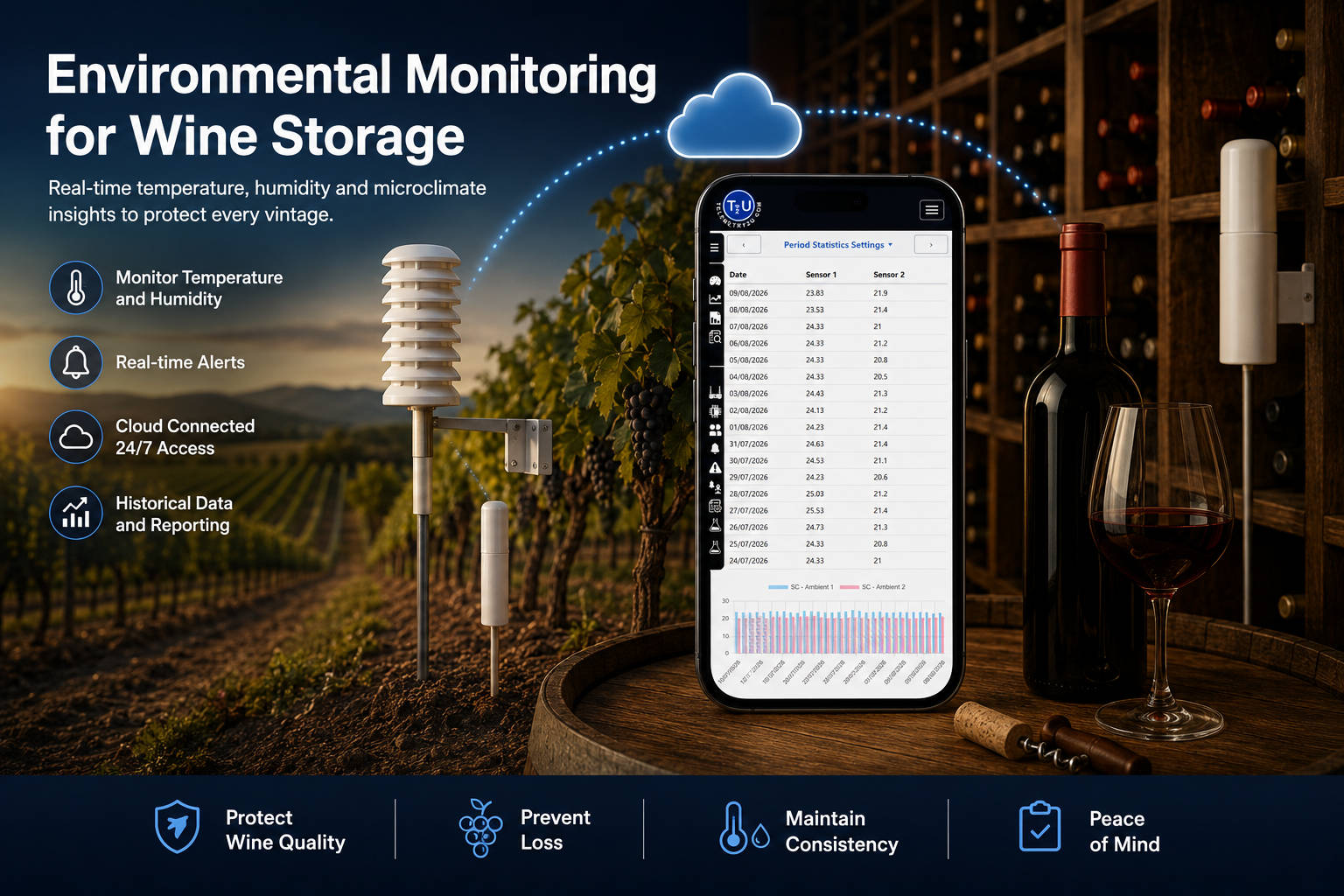
Understand the Environment Across the Whole Wine Storage Area
Wine-storage conditions are not always uniform. Doorways, upper racks, lower levels, cooling outlets and separate rooms can behave differently. Distributed monitoring turns those differences into a long-term record instead of relying on one wall display or an occasional manual reading.

Measure Variation, Trends and Seasonal Behaviour
The Australian Wine Research Institute notes that storage conditions, including temperature and humidity, can influence wine quality and that controlled storage should minimise environmental fluctuations. Telemetry2U provides the monitoring layer so each owner or facility can assess conditions against its own storage requirements.
- Distributed temperature and humidity: Compare multiple points rather than assuming one reading represents the entire cellar.
- Long-term trend history: Review daily cycles, seasonal changes and gradual shifts in cooling or building performance.
- Cross-sensor comparison: Plot common measurements from different rooms, racks or heights on the same chart.
- Early warning of cooling failures: Send configurable email, SMS and voice notifications when temperature, humidity or communications move outside the conditions you define, helping staff investigate refrigeration, HVAC or equipment problems before conditions drift further.
- Configurable operating limits: Apply your own limits and alert logic instead of relying on a universal wine-storage setpoint.
- Multi-site visibility: Bring private cellars, commercial storage rooms, wineries or geographically separate sites into one account.
For independent technical guidance on wine transport and storage conditions, see the Australian Wine Research Institute storage and transport guidance .
Wine Storage Monitoring from Commercial Wineries to Private Cellars
The same monitoring architecture can support a distributed commercial winery or a smaller private collection. Sensor quantity, reporting frequency and data retention can be adjusted to suit the scale, layout and value of the storage environment.
Barrel Rooms, Commercial Cellars & Multi-Site Facilities
Distributed monitoring for commercial environments where conditions can vary between rooms, rack heights, storage zones and buildings.
Winery Barrel Storage
Track temperature and humidity across barrel rooms to identify gradients, daily cycles and seasonal environmental changes.
Commercial Wine Storage
Compare environmental conditions across rooms, aisles, rack heights and customer storage zones.
Multiple Buildings & Sites
View storage rooms, production areas and remote locations through a shared account with controlled user access.
Private Cellars, Hospitality & Maturation Warehouses
The same platform can scale down to individual collections or across related temperature and humidity monitoring applications.
Private Wine Cellars
Monitor a home cellar or high-value private collection remotely and retain a continuous environmental history.
Restaurants & Hotels
Keep wine rooms and hospitality collections visible to authorised staff across one or several venues.
Whisky & Spirit Barrel Warehouses
Apply the same distributed temperature and humidity monitoring approach to maturation warehouses where conditions vary by location or height.
Turn Wine-Storage Sensor Data into Useful Environmental Insight
Wine Storage Monitoring Dashboard
Desktop & Mobile View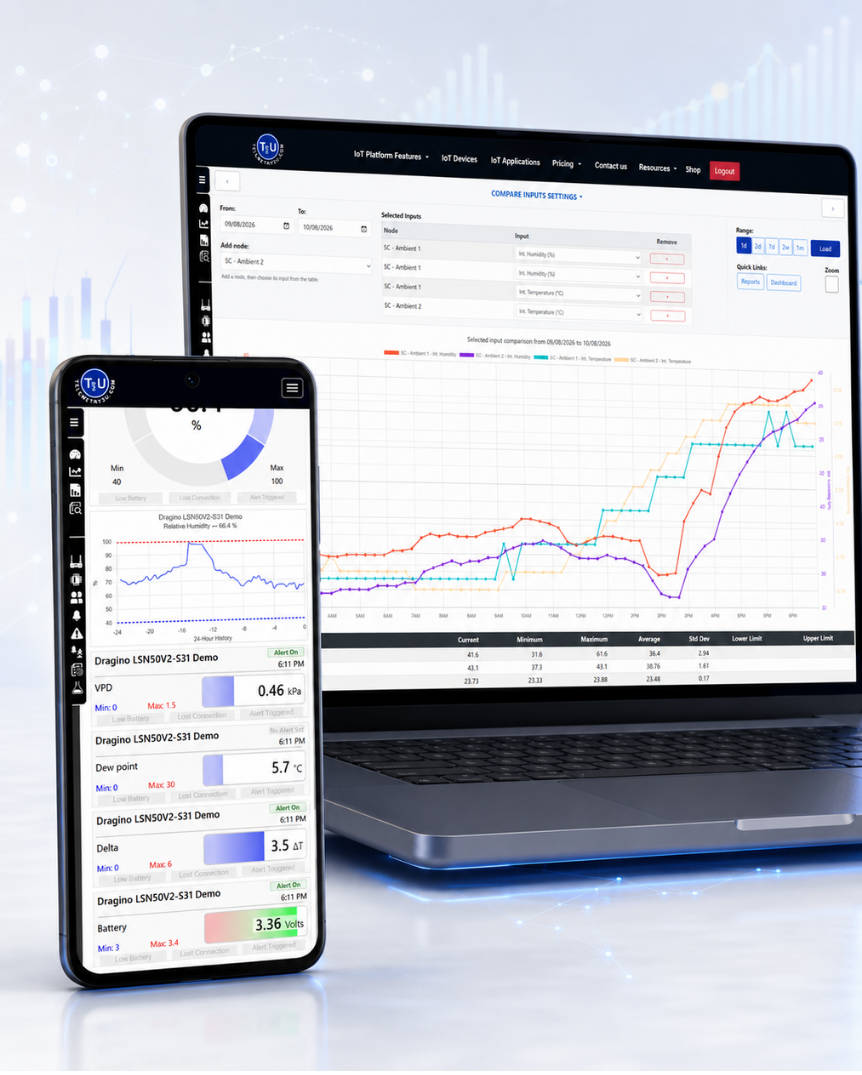
The image above combines current Telemetry2U dashboard and chart views to illustrate how distributed temperature and humidity data can be reviewed on desktop and mobile. Production dashboards are configured around the sensors, rooms and reporting requirements for each site.
Compare Sensors, Not Just Latest Readings
Telemetry2U charts make it practical to compare temperature and humidity across multiple sensor locations. Review a selected period, zoom into events, move through historical data and identify patterns that may not be obvious from a single current-value display.
Historical Analysis, Reports and Alerts in One Platform
- Cross-node charts: compare common measurements from multiple cellar or barrel-room sensors.
- Built-in statistics: review minimum, maximum, average and standard deviation for the selected period.
- Flexible reporting: export data to Excel, CSV or PDF for further review and record keeping.
- API access: retrieve structured data for external tools, custom applications or analysis workflows such as MATLAB.
- Email, SMS and voice alerts: notify selected users when configured temperature, humidity or communication conditions are met.
- Calibration records: apply and retain server-side calibration information where traceability is required.
Choose Wine-Cellar Sensors to Match Accuracy, Budget and Site Conditions
Telemetry2U is not tied to one sensor brand. Senzemo and Dragino provide two practical LoRaWAN options for this application: a higher-accuracy professional microclimate sensor and a lower-cost temperature and humidity sensor. Other compatible hardware can be integrated where it better suits the project.

Senzemo SMC30
A premium indoor LoRaWAN microclimate sensor measuring temperature, relative humidity and atmospheric pressure. The current SMC30 is IP65 rated and uses replaceable AAA batteries.
- Temperature accuracy: ±0.2°C
- Relative humidity accuracy: ±1.8% RH
- IP65 enclosure
- Pressure and movement measurements
- Approx. $190 AUD + GST retail-equivalent benchmark*

Dragino LHT65S
A cost-effective LoRaWAN temperature and humidity sensor with an external temperature-probe connector and onboard data-logging capability for supported recovery workflows.
- Temperature accuracy: ±0.3°C typical
- Relative humidity accuracy: ±3% RH typical
- Built-in 2400 mAh battery
- External temperature sensor connection
- $95 AUD + GST from the Telemetry2U store

Dragino LPS8N Gateway
A practical indoor LoRaWAN gateway for cellar and winery deployments. It can bridge LoRaWAN sensors to Telemetry2U over Ethernet or Wi-Fi, with a cellular-capable version available where backup or independent connectivity is appropriate.
- Supports many LoRaWAN end devices
- Ethernet and 2.4 GHz Wi-Fi connectivity
- Regional LoRaWAN frequency options
- Optional cellular-capable version
- $295 AUD + GST from the Telemetry2U store
Compare the Two Primary Indoor Sensor Options
Published specifications help narrow the choice, but the final sensor should be selected around the required accuracy, environment, battery strategy and project budget.
| Feature | Senzemo SMC30 | Dragino LHT65S |
|---|---|---|
| Positioning | Premium microclimate monitoring | Cost-effective temperature and humidity monitoring |
| Temperature accuracy | ±0.2°C | ±0.3°C typical |
| Humidity accuracy | ±1.8% RH | ±3% RH typical |
| Additional measurements / inputs | Atmospheric pressure and motion | External temperature-probe connection |
| Enclosure / deployment | IP65; suited to demanding indoor environments | Best used in indoor or otherwise protected locations appropriate to the device |
| Battery approach | 2 × replaceable AAA batteries | Built-in 2400 mAh non-chargeable battery |
| Manufacturer battery-life estimate* | Up to 7 years | Up to 10 years |
| Wireless network | LoRaWAN; regional frequency variants available | LoRaWAN; AU915 and other regional frequency plans supported |
| Indicative hardware price | Approx. $190 AUD + GST retail-equivalent benchmark* | $95 AUD + GST |
*Battery-life figures are manufacturer estimates only. Actual life varies with reporting interval, radio conditions, configuration, battery type and operating environment.
*The Senzemo price is an indicative Australian-dollar equivalent based on a current European retail benchmark excluding European VAT and rounded for comparison. It is not a fixed Telemetry2U selling price; current project pricing should be confirmed by quotation.
Not Locked to One Sensor Ecosystem or Network
Senzemo and Dragino are recommended examples, not a closed hardware list. Telemetry2U can assess compatible third-party devices and bring different sensor and communications technologies into the same monitoring platform where the application calls for different accuracy, enclosure, probe, power or connectivity requirements.

LoRaWAN Sensors
Long-range, low-power wireless sensors are the primary fit for distributed cellar, barrel-room and winery monitoring.

LTE-M & NB-IoT
Direct cellular devices can be used where a local LoRaWAN gateway is impractical or a separate communications path is preferred.
RS-485, Modbus & Wired Inputs
Existing wired instruments can be assessed through compatible industrial interfaces and telemetry hardware rather than replaced unnecessarily.

Extend the Same Environmental Monitoring Approach into the Vineyard
Wine storage is the primary focus of this solution, but wineries can extend the same account into vineyard microclimate monitoring when outdoor environmental data is useful alongside cellar and barrel-storage records.
From Vineyard Conditions to Storage Conditions in One Account
Senzemo's SMC30-OUT provides outdoor temperature, relative humidity and air-pressure monitoring over LoRaWAN. Soil moisture, rainfall and leaf wetness can also be added with suitable sensors when the project extends into irrigation, local weather or crop-condition monitoring.
- Outdoor temperature and relative humidity
- Optional soil-moisture monitoring
- Optional rain and leaf-wetness measurements
- Solar-powered LoRaWAN or cellular interface options for remote field locations
- Shared dashboards and historical records across cellar, winery and vineyard sites
Keep detailed agronomy content on the dedicated smart farming monitoring page while using this wine-monitoring system as the common data platform.

Indicative Wine Cellar Monitoring Costs
The simplest way to understand the cost is to separate the one-off hardware and plug-and-play configuration from the recurring Telemetry2U platform cost. These examples show two practical starting points; systems can begin smaller and expand with additional sensors, rooms or sites later.
Platform pricing depends on reporting interval and data retention. The recurring examples below apply to monitored sensors only; the LPS8N gateway does not add a separate platform charge in these examples. Use the Telemetry2U pricing calculator to explore different data plans or request a quotation for a complete system.
3 × Dragino LHT65S Sensors
A practical starting point for a private cellar, small hospitality cellar or compact storage room.
| One-Off System Cost | Indicative Price |
|---|---|
| 3 × Dragino LHT65S at $95 | $285 |
| 1 × Dragino LPS8N gateway | $295 |
| 3 × plug-and-play configuration at $300 | $900 |
| Indicative one-off total | $1,480 + GST |

Recurring Platform Cost
Approximately $180 + GST per year for three sensors using the current illustrative $60-per-sensor annual example at a 20-minute reporting interval with 12-month data retention. Final pricing depends on reporting interval and data retention.
10 × Senzemo SMC30 Sensors
A distributed starting layout for a commercial wine cellar, winery barrel room or maturation storage area.
| One-Off System Cost | Indicative Price |
|---|---|
| 10 × Senzemo SMC30 at approx. $190* | ~$1,900 |
| 1 × Dragino LPS8N gateway | $295 |
| 10 × plug-and-play configuration at $300 | $3,000 |
| Indicative one-off total | ~$5,195 + GST |
Recurring Platform Cost
Approximately $600 + GST per year for ten sensors using the current illustrative $60-per-sensor annual example at a 20-minute reporting interval with 12-month data retention. Final pricing depends on reporting interval and data retention.
What the $300 Plug-and-Play Configuration Covers
Telemetry2U prepares each supplied sensor and the customer platform before dispatch, so the system arrives as a configured monitoring solution rather than a collection of unconfigured devices.

Hardware Prepared
- Sensor preparation and testing
- LoRaWAN and device configuration
- Supplied gateway configuration included

Platform Ready
- Platform device registration
- Customer account and initial user setup
- Initial dashboard configuration

Alerts & Handover
- Initial alert configuration where requested
- Configured ready for customer deployment
- Australian-based support for deployment questions
Distributor and integrator pricing is available for suitable plug-and-play projects.
All prices are shown in AUD excluding GST and are indicative only. Hardware availability and quoted prices can change. The Senzemo allowance is based on the current overseas retail benchmark described in the hardware section.
Start with One Cellar. Scale to Every Room, Building or Site.
Add sensors without rebuilding the monitoring system. Telemetry2U can grow from a small three-sensor cellar to larger rooms with 10, 20 or more monitoring points, then extend into other winery buildings, vineyard locations or international sites under the same platform. Hardware can be prepared for the appropriate regional LoRaWAN frequency plan. The platform runs on dedicated Australian-hosted infrastructure while supporting monitoring deployments internationally.
Wine Cellar Monitoring FAQ
Practical answers for private collectors, wineries, hospitality venues and commercial wine-storage facilities considering remote temperature and humidity monitoring.
The appropriate limits depend on the wine, cellar design, storage method and the organisation's own operating requirements. Telemetry2U does not prescribe a universal setpoint. The platform records conditions over time and allows customers to apply their own temperature and humidity limits for dashboards, analysis and alerts.
A small private cellar may start with around three sensors, while larger commercial rooms may use 10, 20 or more monitoring points. The number depends on room size, layout, rack height, airflow and how much spatial detail is required. Sensors can be placed at different heights and locations to identify environmental variation rather than relying on one reading for the whole room.
Often, yes. One LoRaWAN gateway can support many compatible sensors, and a typical cellar or storage facility may only need one gateway. Actual coverage depends on building construction, distance, metal structures, underground areas and the local radio environment, so additional gateways can be added where required.
Yes. Telemetry2U is designed to scale from a small cellar to multiple rooms, buildings, wineries or vineyard locations. Additional compatible sensors, gateways, users and dashboards can be added to the same account as the monitoring requirement grows.
Yes, subject to technical compatibility. Telemetry2U can integrate a wide range of third-party LoRaWAN hardware and can also assess LTE-M, NB-IoT, RS-485, Modbus and other wired sensor interfaces where they are better suited to the site. Senzemo and Dragino are practical examples rather than a closed hardware ecosystem.
Yes. Customers can configure temperature, humidity and communication conditions and route notifications to selected users by email, SMS or voice call. Alert settings, delays, recipients and escalation rules are configurable, while the same sensor data remains available for longer-term trend analysis.
Telemetry2U supports historical charts, cross-sensor comparisons and statistics including minimum, maximum, average and standard deviation. Data can be exported in Excel, CSV or PDF formats, and secure API access is available for external analysis tools and software workflows.
Related Wine Storage, Environmental Monitoring and IoT Resources
Explore related monitoring applications, platform features and deployment resources for extending wine-cellar monitoring across wineries, vineyards and other environmental monitoring requirements.

Related Monitoring Applications
Explore adjacent applications for vineyards, growing environments, food storage and wider IoT monitoring.
Dashboards, Alerts & Data
See how sensor readings become historical charts, statistics, notifications and structured data access.
Hardware & Deployment
Review compatible hardware, network choices, Senzemo setup guidance and Telemetry2U plug-and-play deployment.